Posted on
/
By
Clay Thomas
All Japan eSIM providers tell you the same things. Which networks they cover, how much data you get, and how many days you have on your plan. Most won't tell you the real speeds you can actually experience in Japan, at the locations you are most likely to visit.
In this speed test database we continue to test and record the real speeds, service and reliability of Japan eSIMs. Every test is carried out in person, with over 300 results recorded so far, including our own Journey Japan eSIM.
Whether you are staying in inner city Tokyo, travelling between cities on the Shinkansen, or exploring Kyoto's mountainside temples and bamboo forest, you can see the speeds you can actually rely on. The overall results are below, followed by every location on its own.
eSIMs tested
Journey Japan eSIM: Japan-only eSIM founded by Chris Broad of Abroad in Japan.
Mobal: Japan-based provider, and one of the few that can issue a visitor a Japanese phone number.
Sakura Mobile: Japan-based provider selling eSIM, physical SIMs and pocket WiFi.
Airalo: Global eSIM marketplace covering more than 200 destinations.
Holafly: Global travel eSIM built around unlimited data plans.
Saily: Global travel eSIM from the team behind NordVPN.
Japan eSIM speed test results
This data covers all results recorded across Japan so far, as of September 2026. Every test was run in person by our team using the same set parameters, then compiled here so at a glance you can see how each eSIM performed overall: the speeds it reached, how consistent it was, and whether it failed to connect at all.
For how these tests were run, and what each measurement actually means for your connection, see the end of this article.
eSIM | Average speed (Mbps) | Upload (Mbps) | Lowest (Mbps) | Fastest (Mbps) | Latency (ms) | Failed tests |
|---|---|---|---|---|---|---|
Journey Japan eSIM | 204.5 | 29.3 | 5.4 | 910 | 24 | 0 |
Saily | 119.6 | 20.6 | 0.86 | 760 | 30 | 6 |
Mobal | 84.5 | 16.8 | 4.6 | 270 | 26 | 0 |
Airalo | 23.5 | 12.7 | 3.7 | 170 | 80 | 2 |
Sakura Mobile | 16.2 | 11.2 | 2.7 | 54 | 45 | 0 |
Holafly | 7.2 | 9.6 | 0.22 | 10 | 129 | 1 |
Last updated: September 2026
17 locations tested across Japan | more than 300 speed tests recorded and documented | 6 eSIM providers
How to read this table
Average speed: the average download speed across every test recorded for that eSIM.
Upload: the average upload speed across those same tests.
Lowest and Fastest: the slowest and fastest single results recorded, which gives you an idea of the range you might realistically see.
Latency: how quickly the network responds, measured in milliseconds. Lower is better. Under 30 ms feels instant, 40 to 60 ms feels normal, and anything above 70 ms starts to show as lag on video calls.
Failed tests: tests the eSIM could not complete or connect for at all.
An eSIM sitting outside the top of these rankings is not unusable. Most can still handle the basics, like maps, light messaging and checking email. Speed and connection quality start to matter a great deal more once you add hotspotting, social media, streaming, video calls, uploads or remote work, or if you simply want things to load the moment you ask for them.
Japan eSim Speed Test Results by location
Osaka
Osaka is Japan's second largest metropolitan area and probably its most famous for food. It offers a lot of variety in a small area, from old historical monuments to the lively modern districts. It also returned the highest speeds of anywhere we connected so far.
Osaka Castle
Network: 5G / LTE
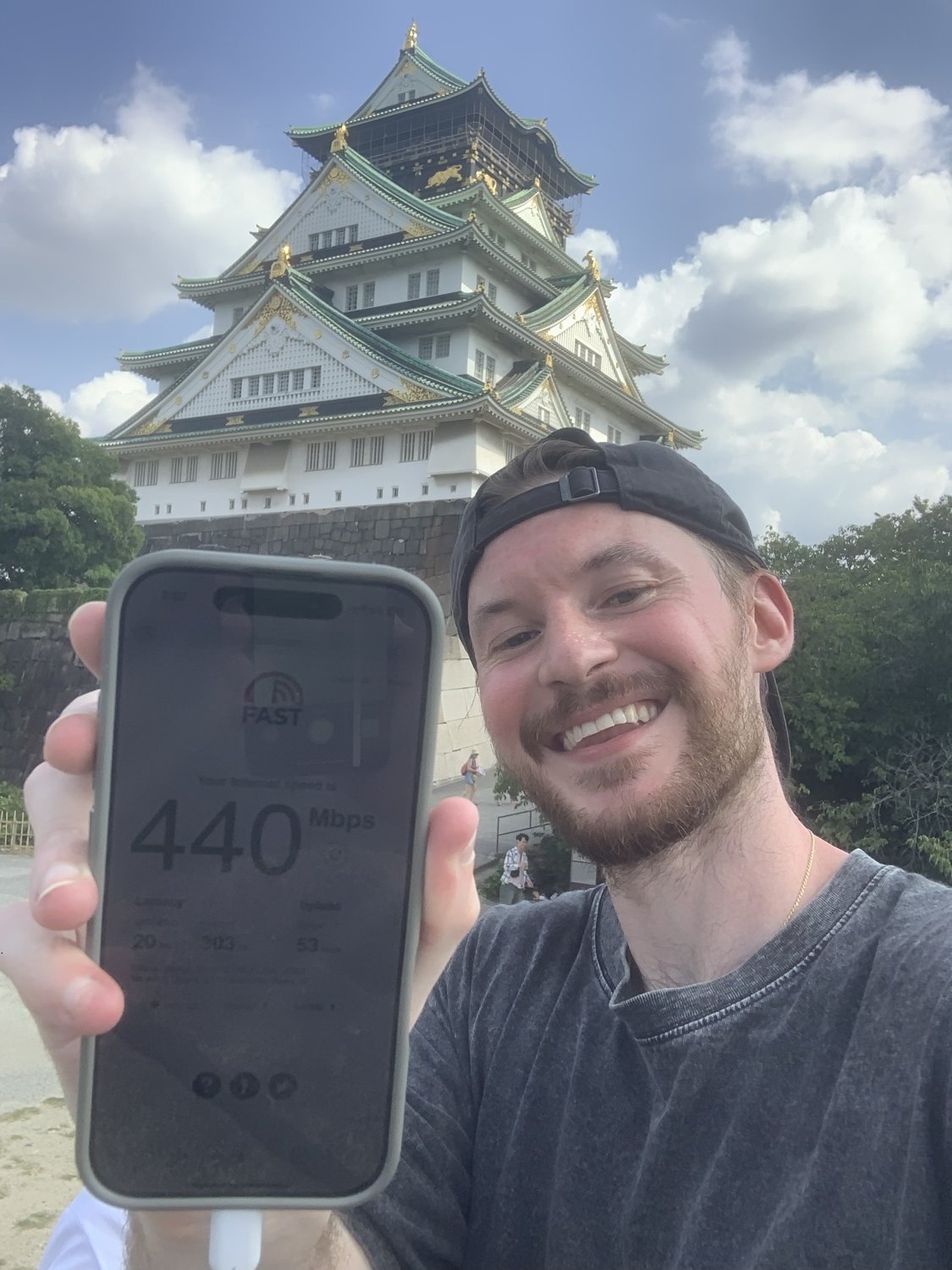
Speed test recorded at Osaka Castle
Osaka Castle is the centrepiece of the city for its history and its grounds. A wide open area clear of any obstruction overhead, which gives about as clean a line to the nearest mast as anywhere in Osaka.
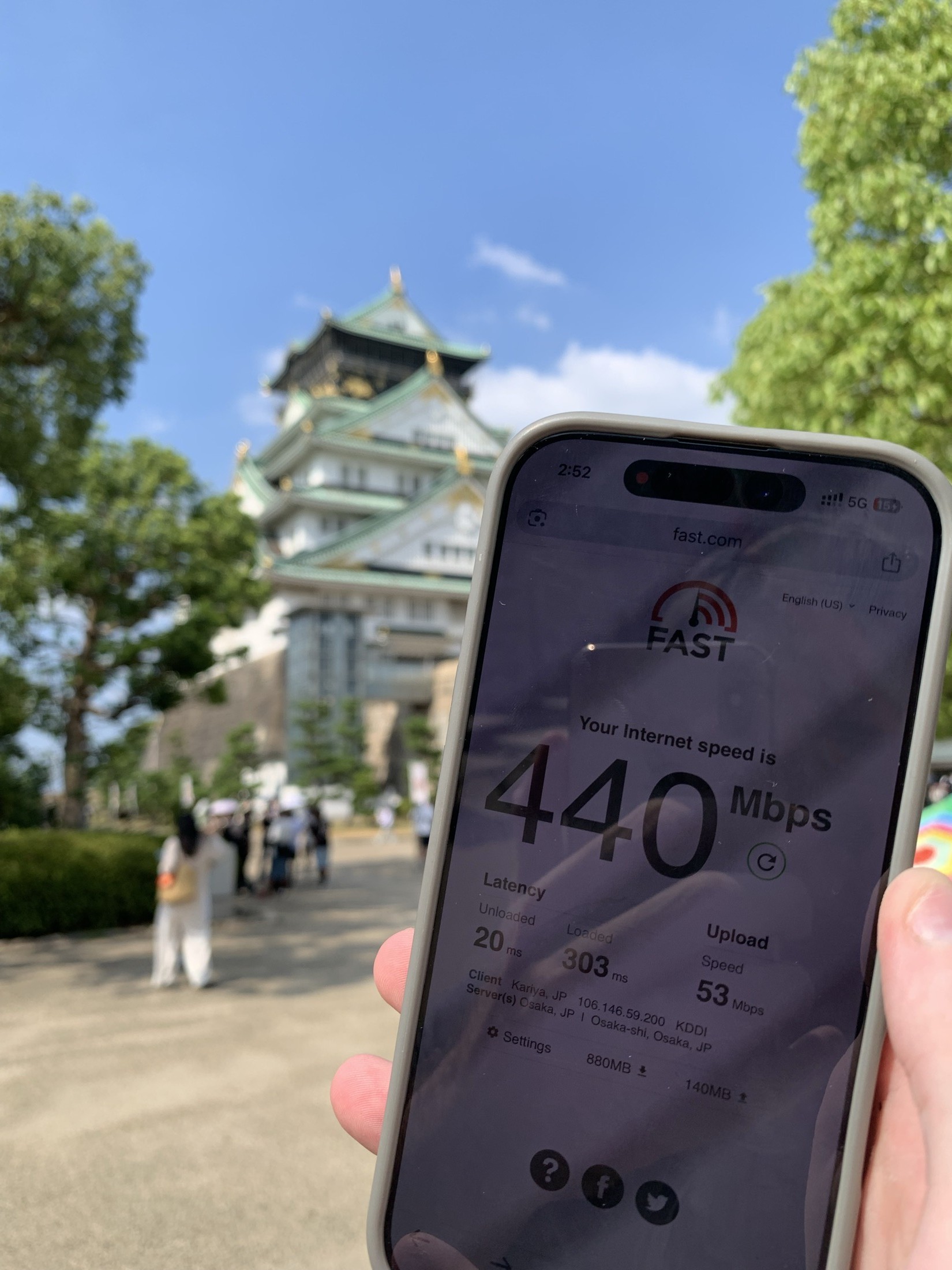
440 Mbps recorded at Osaka Castle
eSIM | Average, best 3 (Mbps) | Best (Mbps) | Upload (Mbps) | Latency (ms) | Reliability |
|---|---|---|---|---|---|
JJESIM | 380 | 440 | 26 | 20 | Strong |
Mobal | 230 | 270 | 22 | 22 | Strong |
Sakura | 14 | 17 | 13 | 32 | Stable |
Saily | 1 | 1 | 5 | 26 | Weak |
Airalo | 20 | 20 | 15 | 74 | Stable |
Holafly | 9 | 10 | 12 | 119 | Weak |
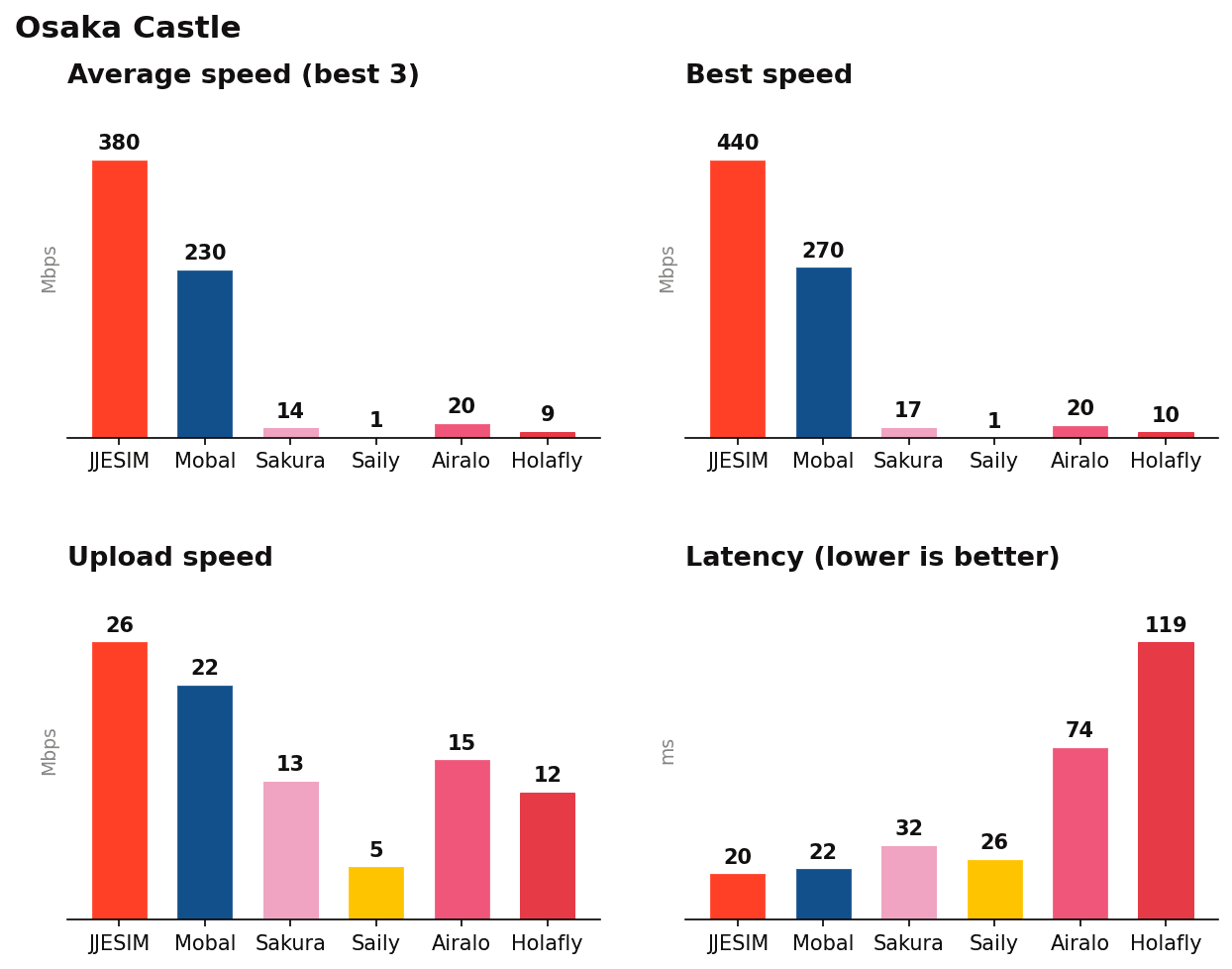
Osaka Castle: download, upload, latency and reliability by provider
Journey Japan averaged 380 Mbps with a best of 440. Mobal averaged 230 with a best of 270. Airalo returned 20 Mbps, Sakura Mobile 17 and Holafly 10. Saily completed one run at 1 Mbps and is marked weak here.
Namba / Dotonbori
Network: 5G
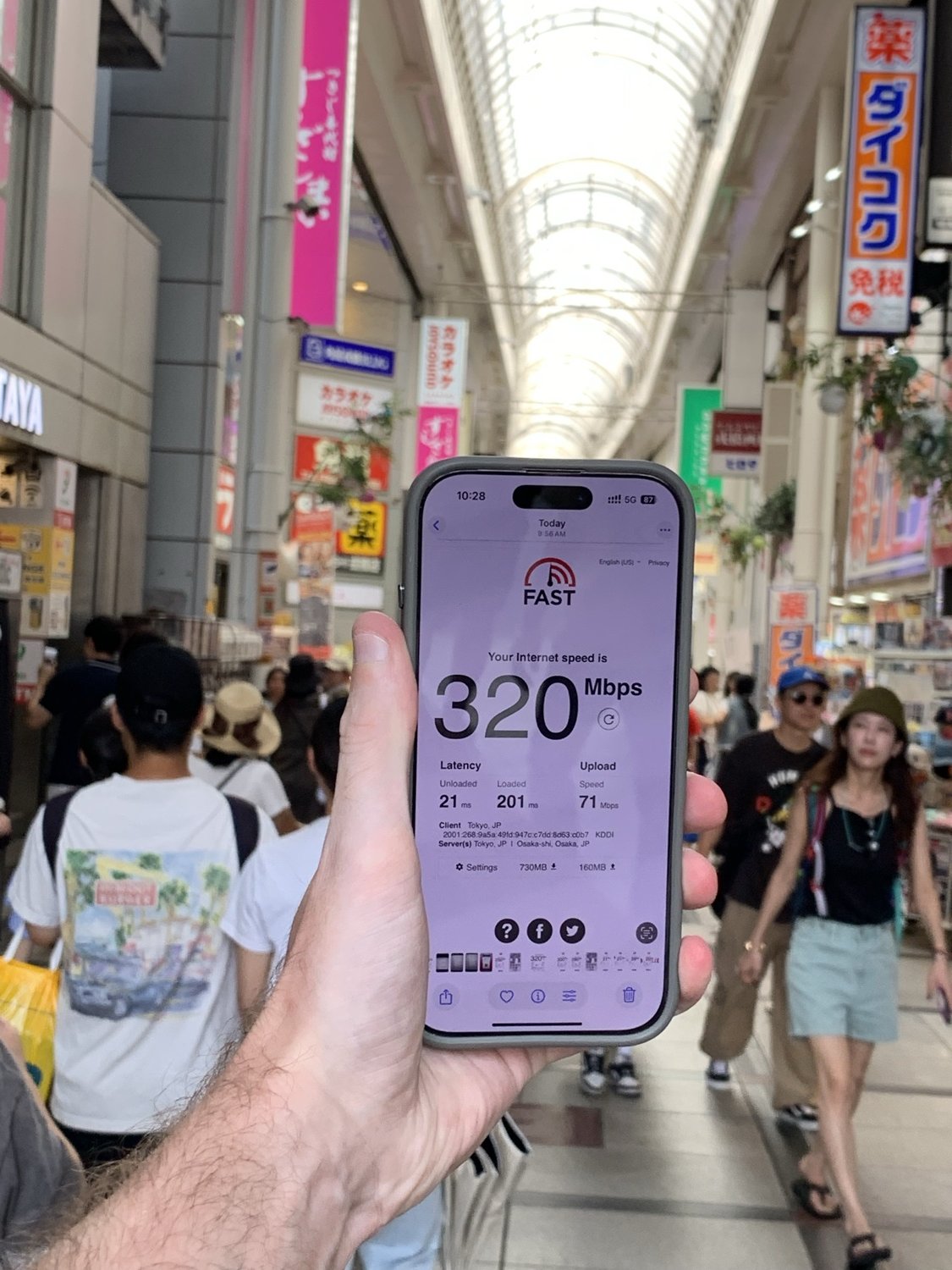
Speed test recorded at Namba / Dotonbori
Osaka's best known food and nightlife district, and one of the busiest streets in the city. Tested inside the covered arcade, where the roofing overhead and the crowd density both work against a signal.
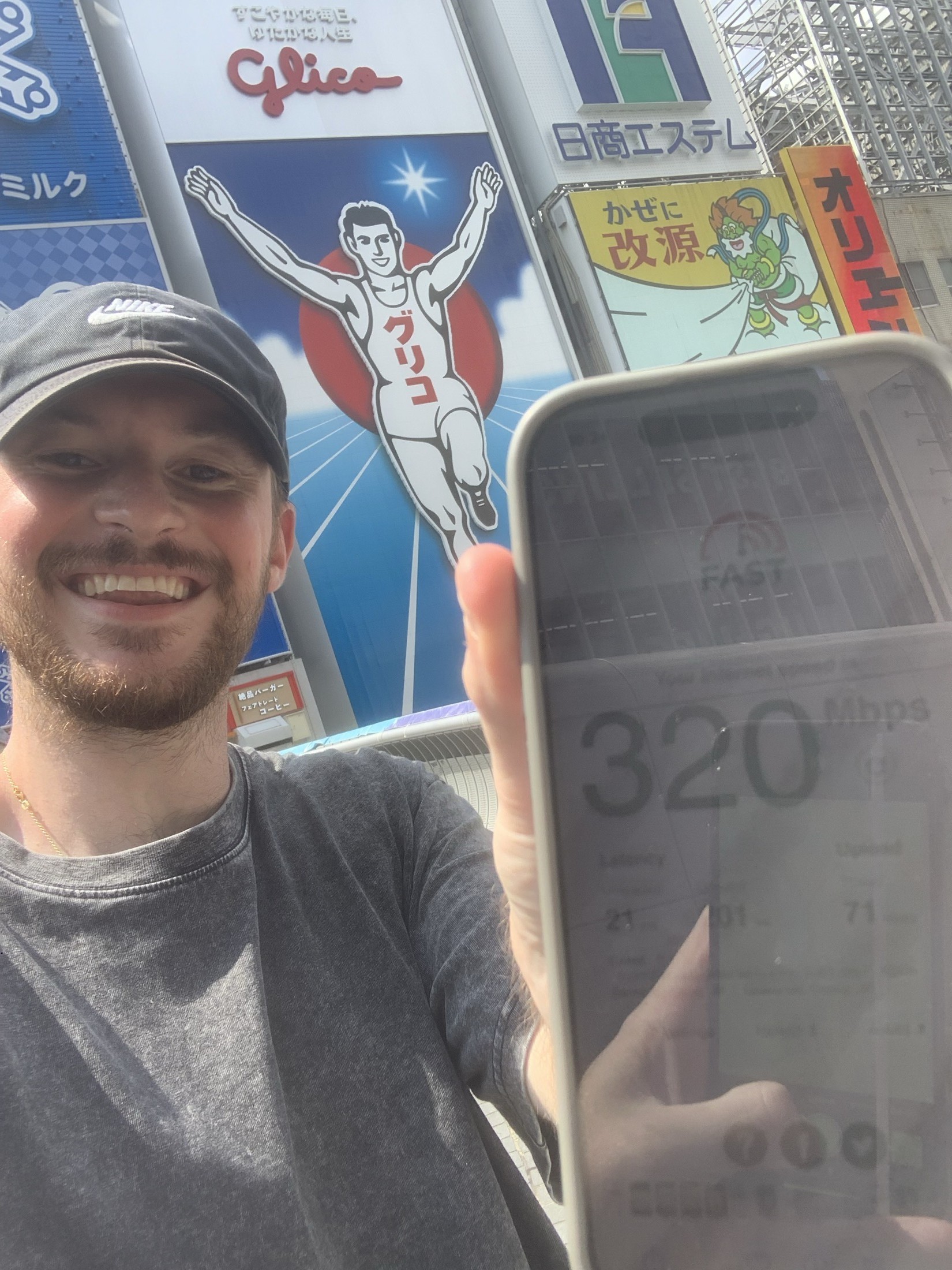
320 Mbps recorded at in front of the "Glico Running Man Sign' in Osaka.
eSIM | Average, best 3 (Mbps) | Best (Mbps) | Upload (Mbps) | Latency (ms) | Reliability |
|---|---|---|---|---|---|
JJESIM | 300 | 320 | 63 | 19 | Strong |
Mobal | 170 | 180 | 30 | 23 | Strong |
Sakura | 20 | 20 | 7 | 37 | Stable |
Saily | 237 | 390 | 50 | 28 | Strong |
Airalo | 20 | 20 | 14 | 73 | Stable |
Holafly | 8 | 8 | 15 | 116 | Weak |
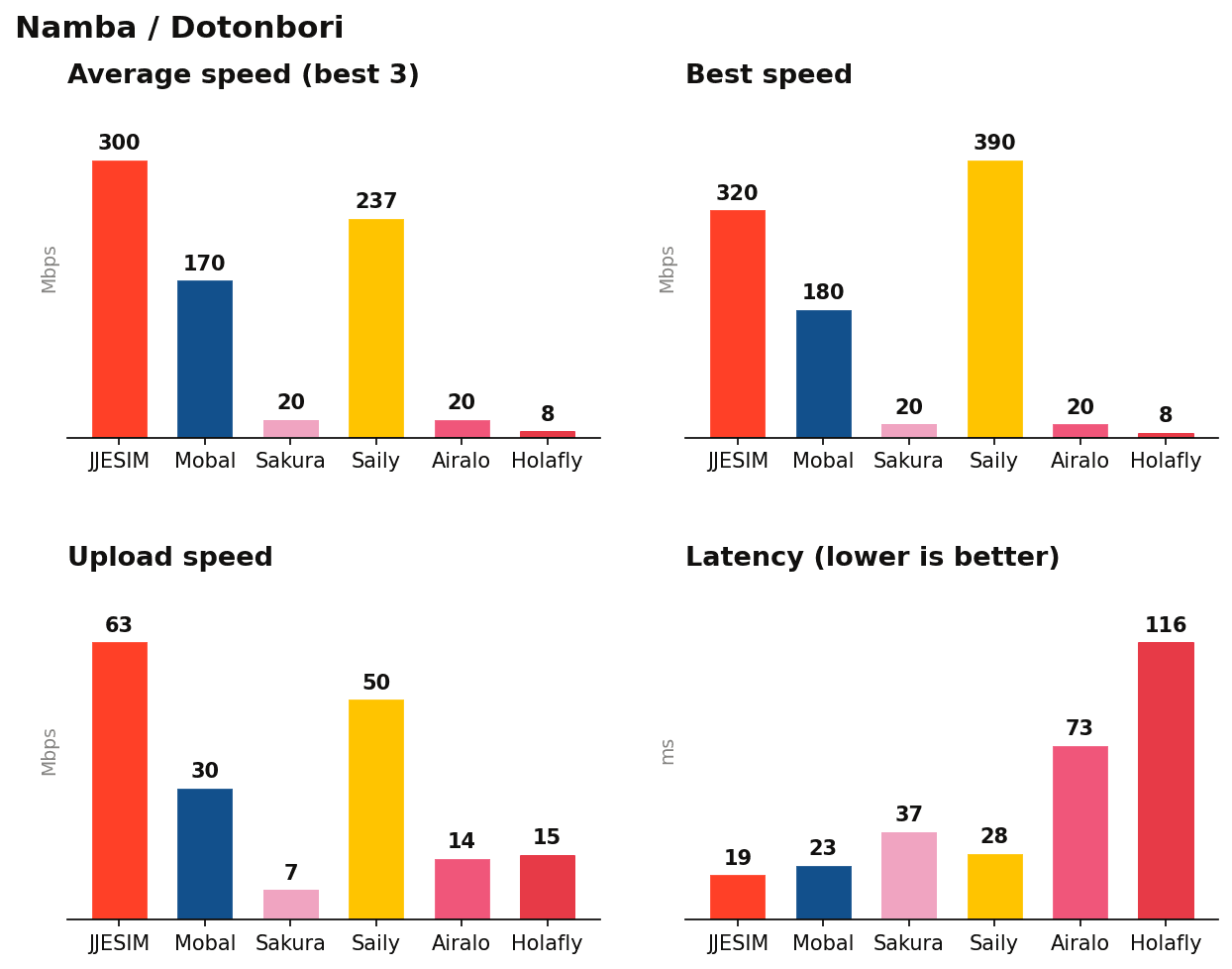
Namba / Dotonbori: download, upload, latency and reliability by provider
Saily recorded the single fastest run at this location, 390 Mbps, though its results ranged from 120 to 390 across attempts. Journey Japan averaged 300 Mbps with a best of 320 and the lowest latency in the group at 19 ms. Mobal averaged 170 Mbps. Sakura Mobile and Airalo both returned 20 Mbps, and Holafly 8 Mbps.
Tennoji / Tsutenkaku
Network: 5G / LTE
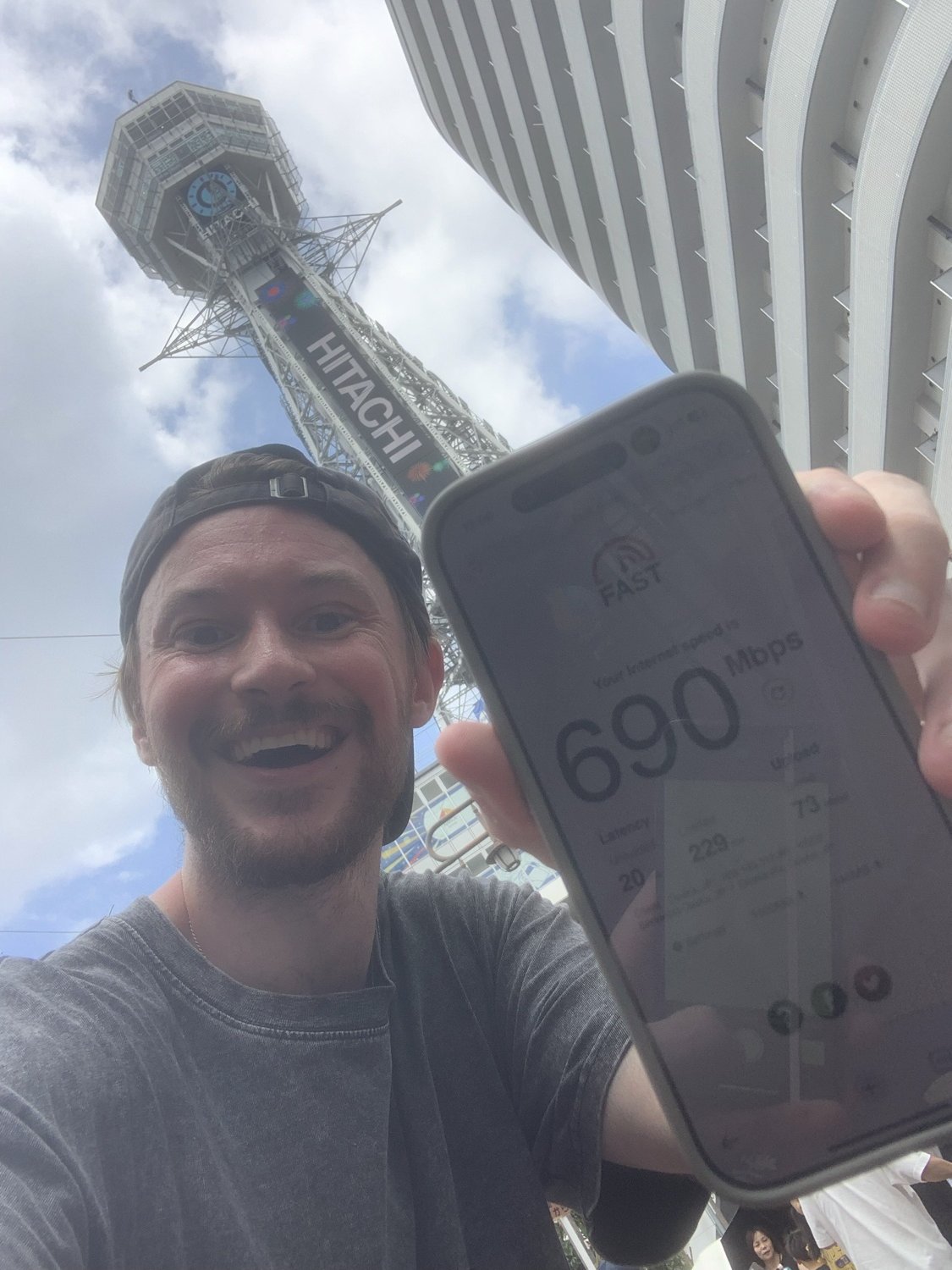
Speed test recorded at Tennoji / Tsutenkaku
A retro district in south Osaka built around the Tsutenkaku tower. Tested at street level, with dense low-rise building cover on all sides and the tower itself directly overhead.
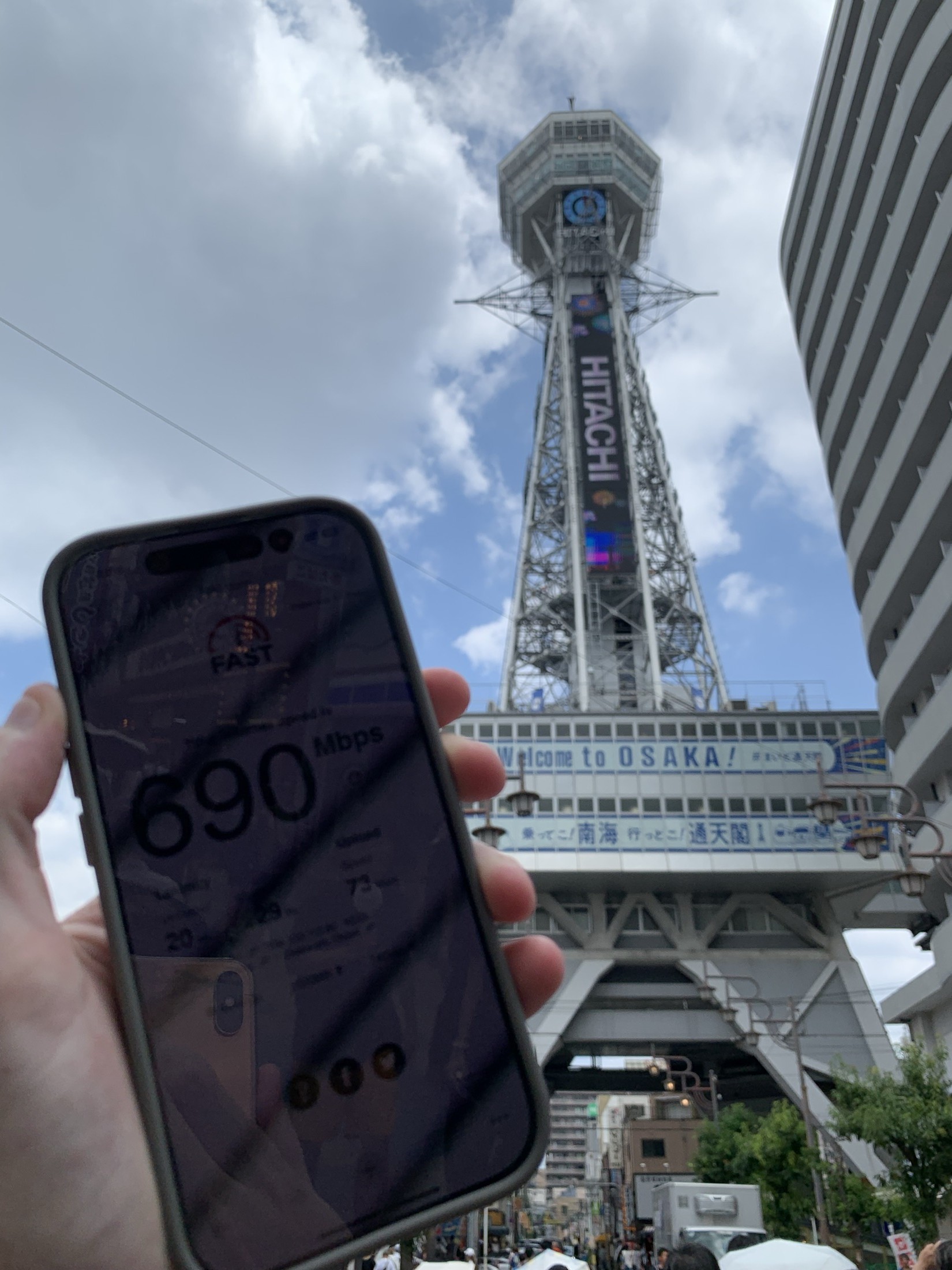
690 Mbps recorded at Tennoji / Tsutenkaku
eSIM | Average, best 3 (Mbps) | Best (Mbps) | Upload (Mbps) | Latency (ms) | Reliability |
|---|---|---|---|---|---|
JJESIM | 633 | 690 | 72 | 18 | Strong |
Mobal | 513 | 670 | 59 | 22 | Strong |
Sakura | 14 | 23 | 14 | 34 | Stable |
Saily | 547 | 740 | 45 | 28 | Strong |
Airalo | 19 | 20 | 14 | 73 | Stable |
Holafly | 9 | 9 | 14 | 119 | Weak |
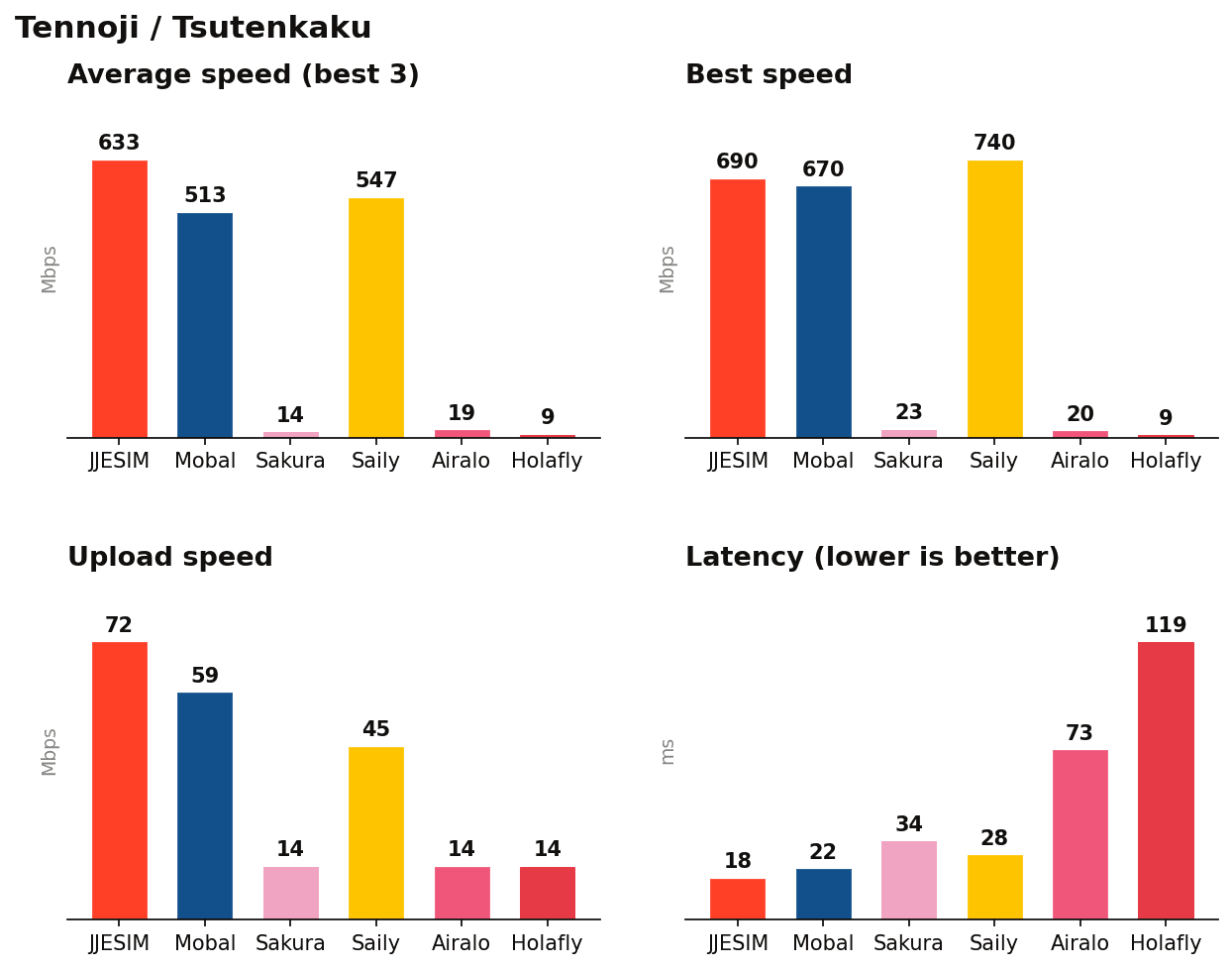
Tennoji / Tsutenkaku: download, upload, latency and reliability by provider
Saily recorded the highest single run at 740 Mbps, ahead of Journey Japan at 690 and Mobal at 670. On best-three averages the order was Journey Japan 633 Mbps, Saily 547 and Mobal 513. Sakura Mobile did not exceed 23 Mbps, Airalo returned 20 and Holafly 9.
USJ (Universal Studios Japan)
Network: 5G
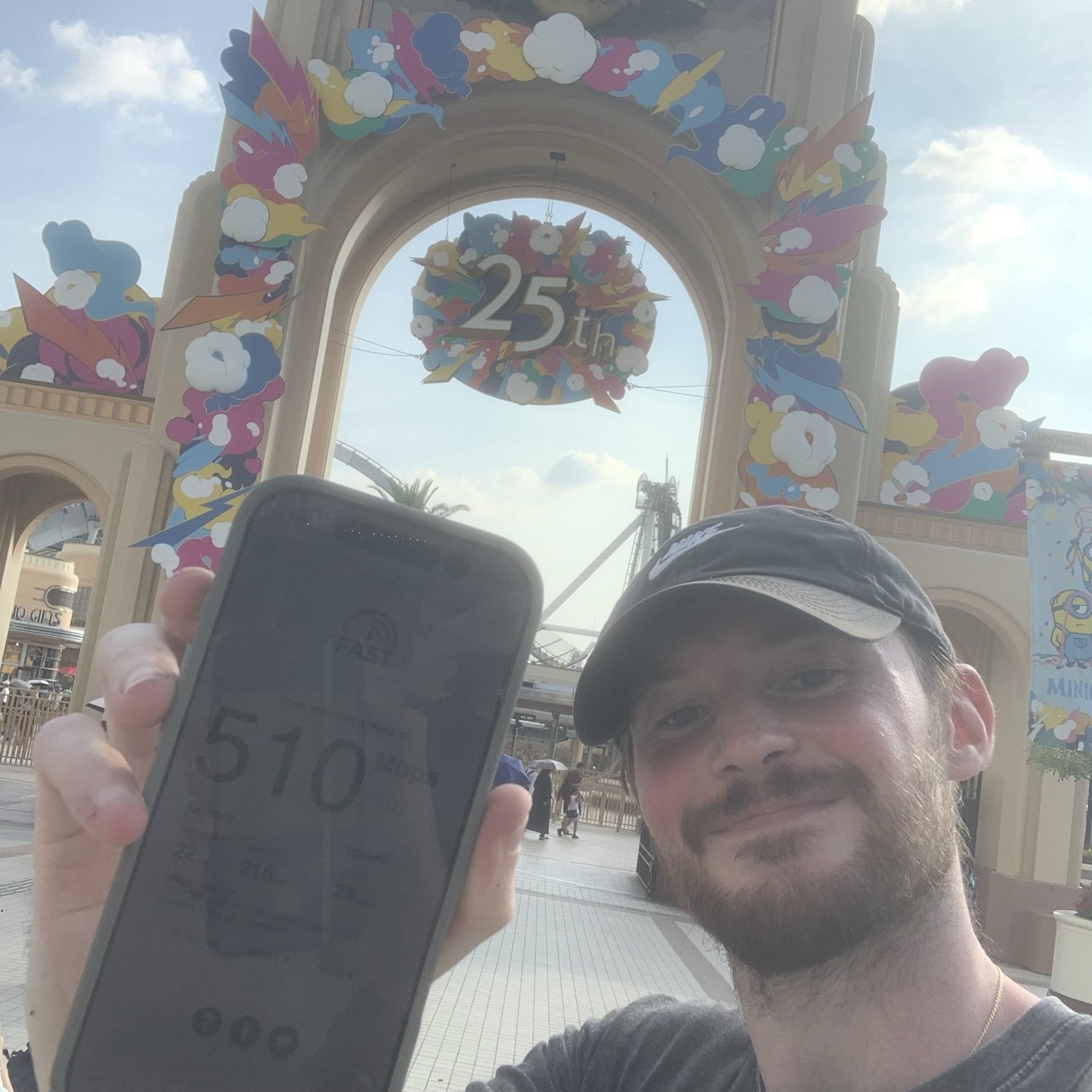
Speed test recorded at USJ (Universal Studios Japan)
One of the busiest theme parks in Japan. Tested at the entrance gates during opening hours, where crowd density is at its highest and every handset in the queue is competing for the same cell.
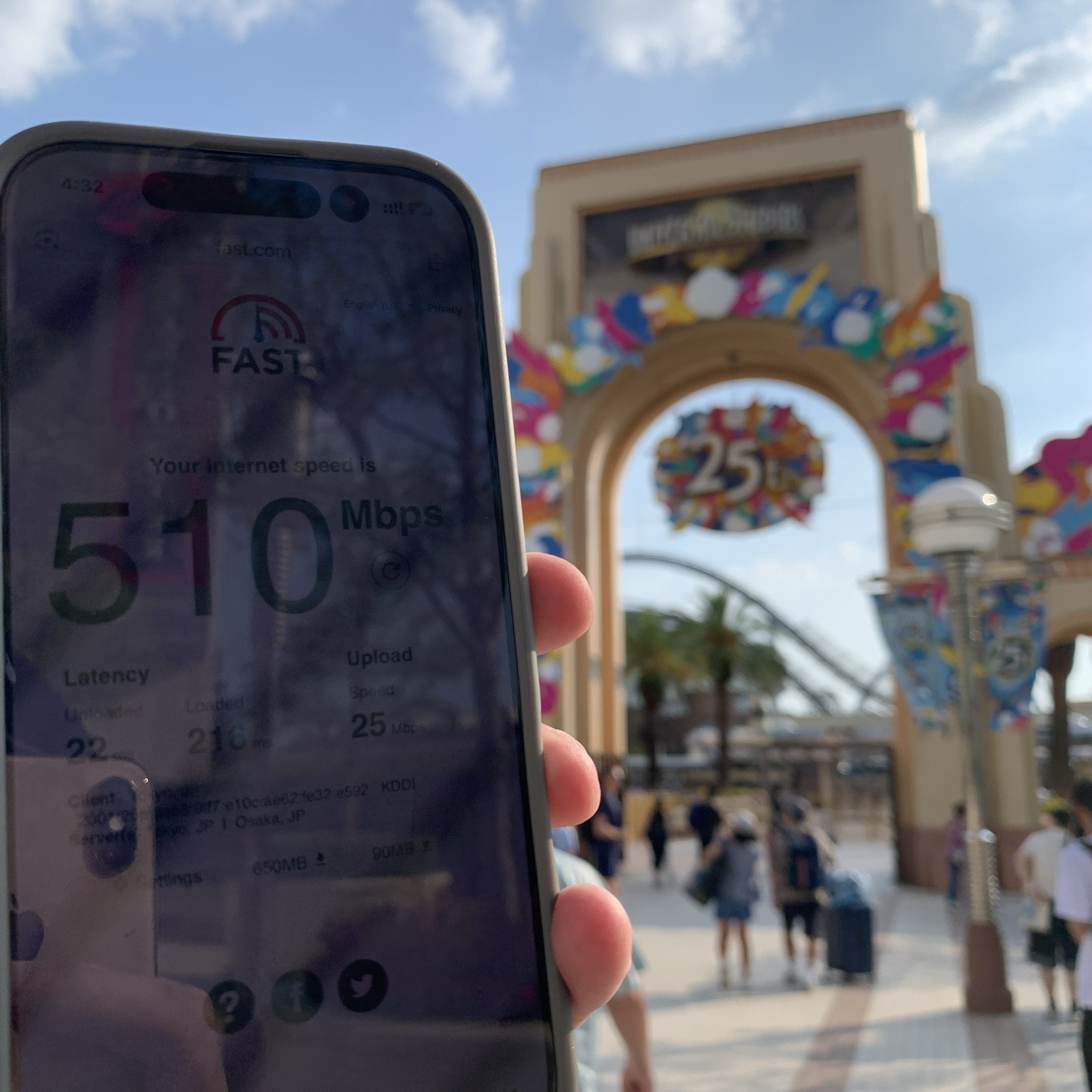
510 Mbps recorded at USJ (Universal Studios Japan)
eSIM | Average, best 3 (Mbps) | Best (Mbps) | Upload (Mbps) | Latency (ms) | Reliability |
|---|---|---|---|---|---|
JJESIM | 383 | 510 | 38 | 24 | Strong |
Mobal | 317 | 440 | 50 | 24 | Strong |
Sakura | 17 | 19 | 9 | 43 | Stable |
Saily | 1 | 1 | 2 | 16 | Dropped 1x |
Airalo | 21 | 23 | 15 | 79 | Stable |
Holafly | 9 | 9 | 14 | 121 | Weak |
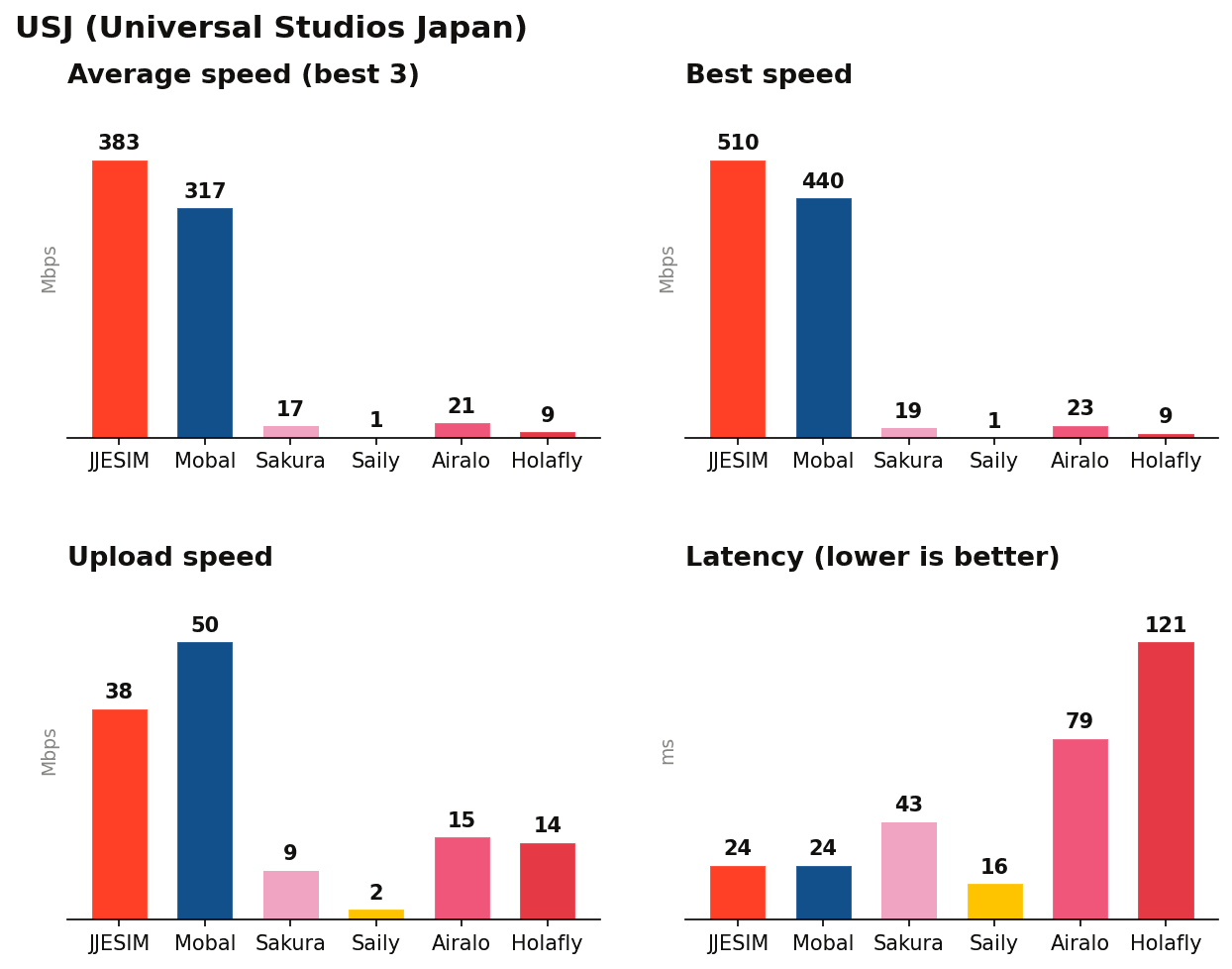
USJ (Universal Studios Japan): download, upload, latency and reliability by provider
Journey Japan averaged 383 Mbps with a best of 510. Mobal averaged 317 with a best of 440, and recorded the highest upload in the group at 50 Mbps. Airalo returned 23 Mbps, Sakura Mobile 19 and Holafly 9. Saily dropped one test and completed another at 1 Mbps.
Shin-Osaka Station
Network: 5G
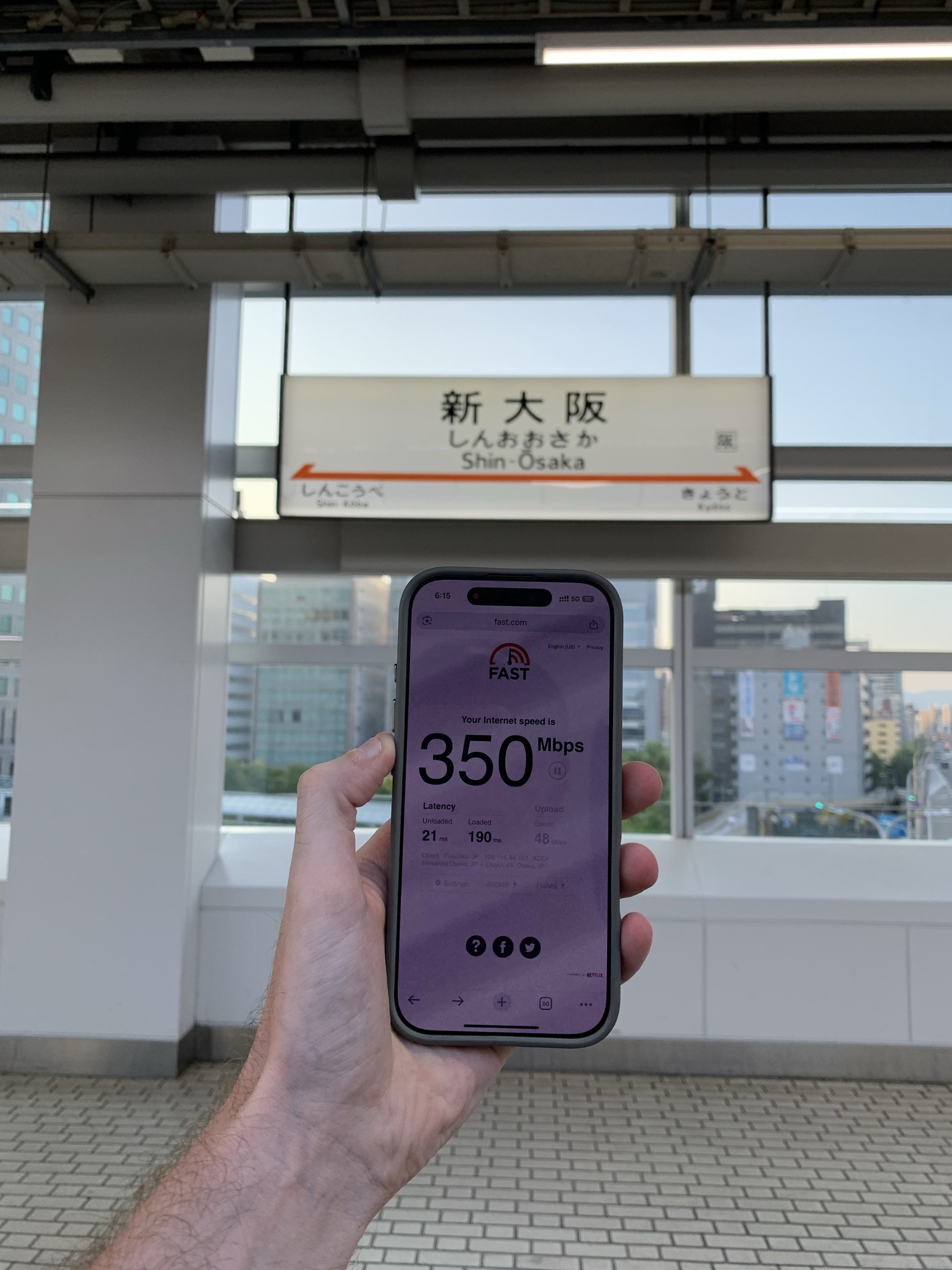
Speed test recorded at Shin-Osaka Station
The city's Shinkansen hub and the arrival point for most visitors coming from Tokyo. An open raised platform with clear sky above and heavy commuter traffic at the time of testing.
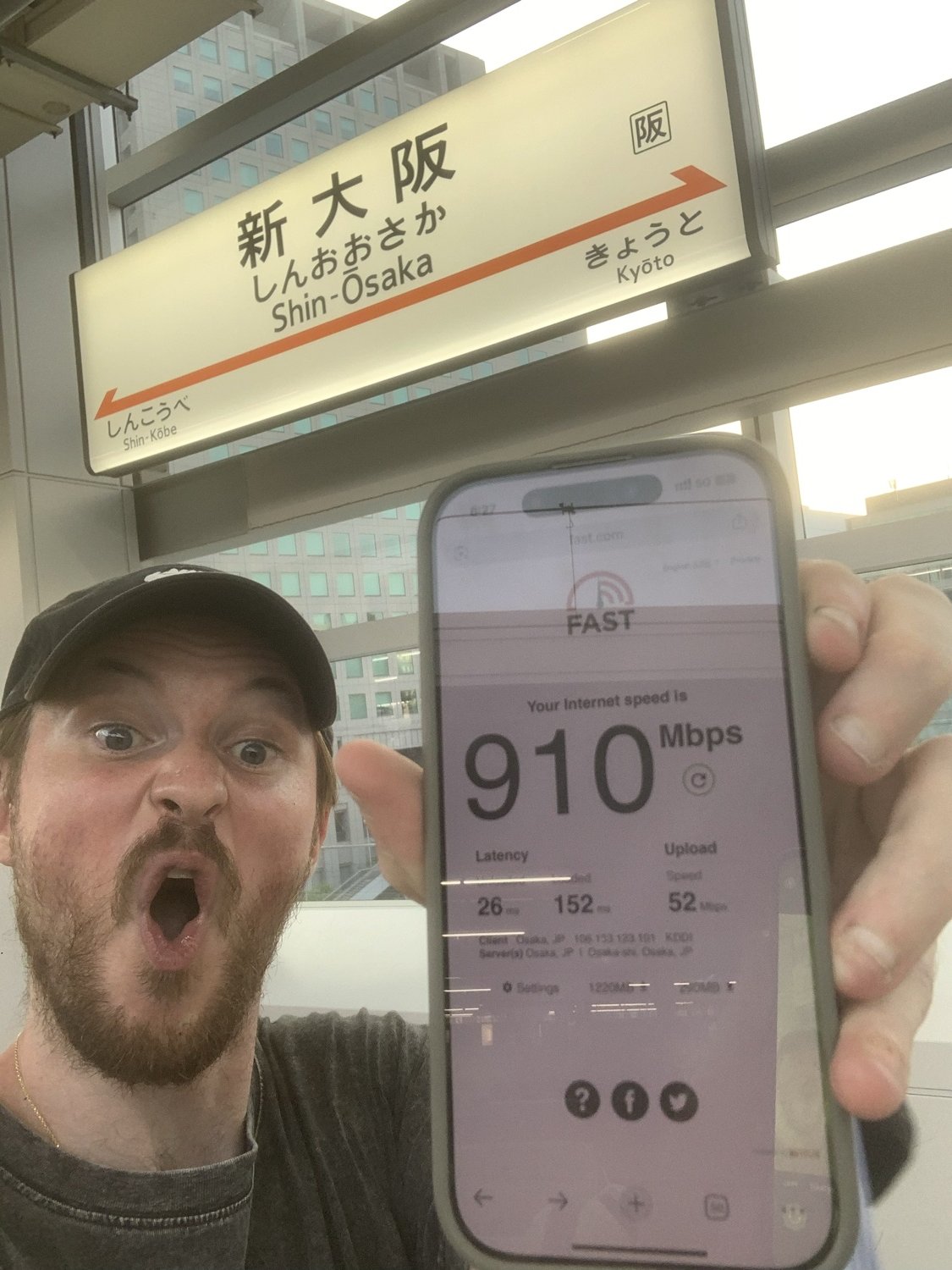
910 Mbps recorded at Shin-Osaka Station
eSIM | Average, best 3 (Mbps) | Best (Mbps) | Upload (Mbps) | Latency (ms) | Reliability |
|---|---|---|---|---|---|
JJESIM | 780 | 910 | 52 | 24 | Strong |
Mobal | 465 | 570 | 42 | 20 | Strong |
Saily | 1 | 1 | 7 | 34 | Weak |
Airalo | 20 | 20 | 17 | 81 | Stable |
Holafly | 9 | 9 | 11 | 121 | Weak |
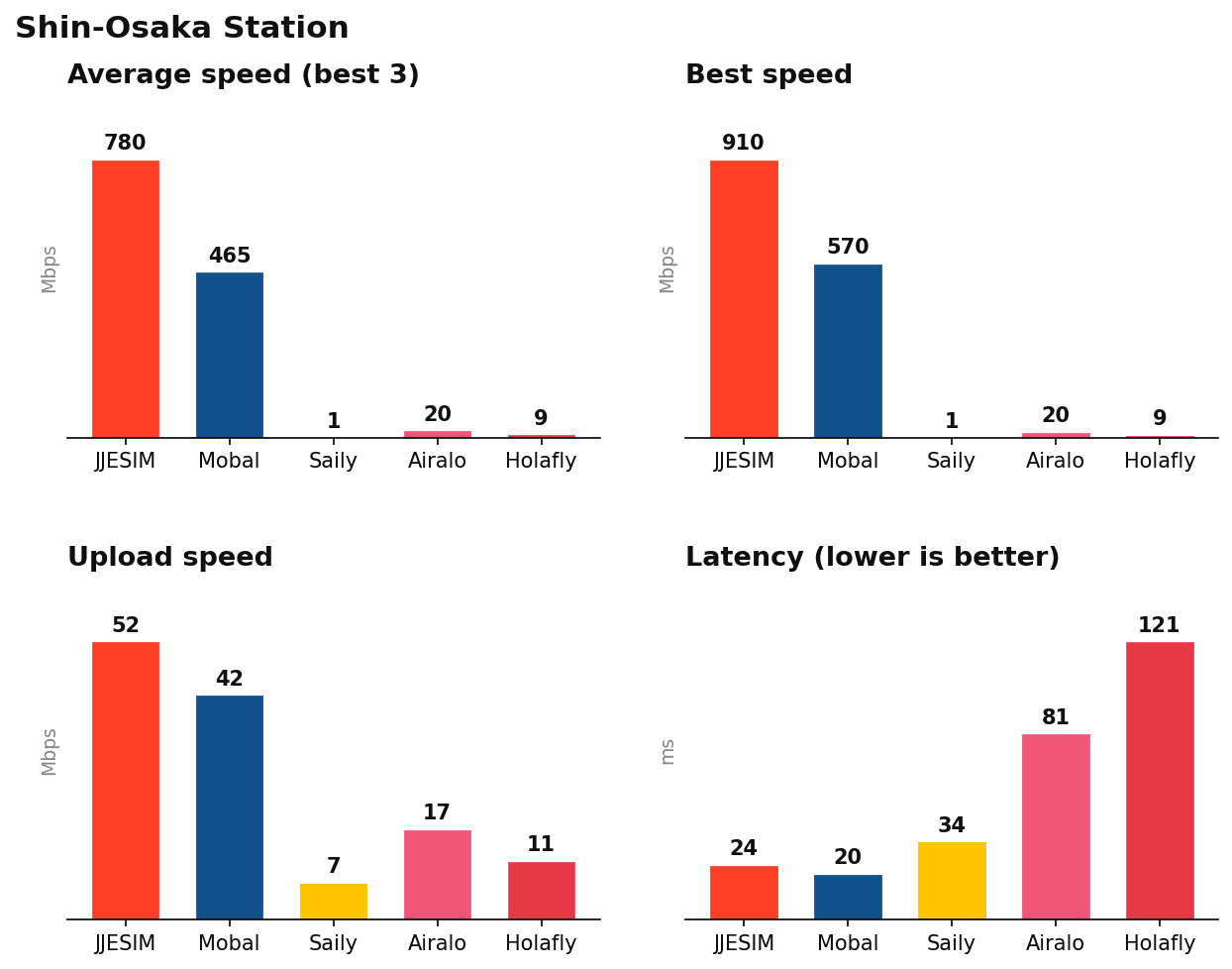
Shin-Osaka Station: download, upload, latency and reliability by provider
Journey Japan recorded 910 Mbps, with the meter briefly reading over 1 Gbps mid-test. and currentl holds the highest speed test recorded. Mobal's best was 570 Mbps. Airalo returned 20 Mbps and Holafly 9 Mbps. Saily completed a single run at 1 Mbps and is marked weak at this location. Idle latency ranged from 20 ms on Mobal to 121 ms on Holafly.
Kyoto
Kyoto is another top location for first time travelers and tourists. It is also where the difference in network coverage and data speeds between providers showed most. Signal holds up well in the city centre, then drops off quickly once you get out to the temples and the bamboo grove.
Kyoto Station
Network: 5G / LTE

Speed test recorded at Kyoto Station
Kyoto's main rail gateway and the first ground most visitors stand on in the city. A large enclosed concourse under a high steel and glass roof, tested late evening with light foot traffic.
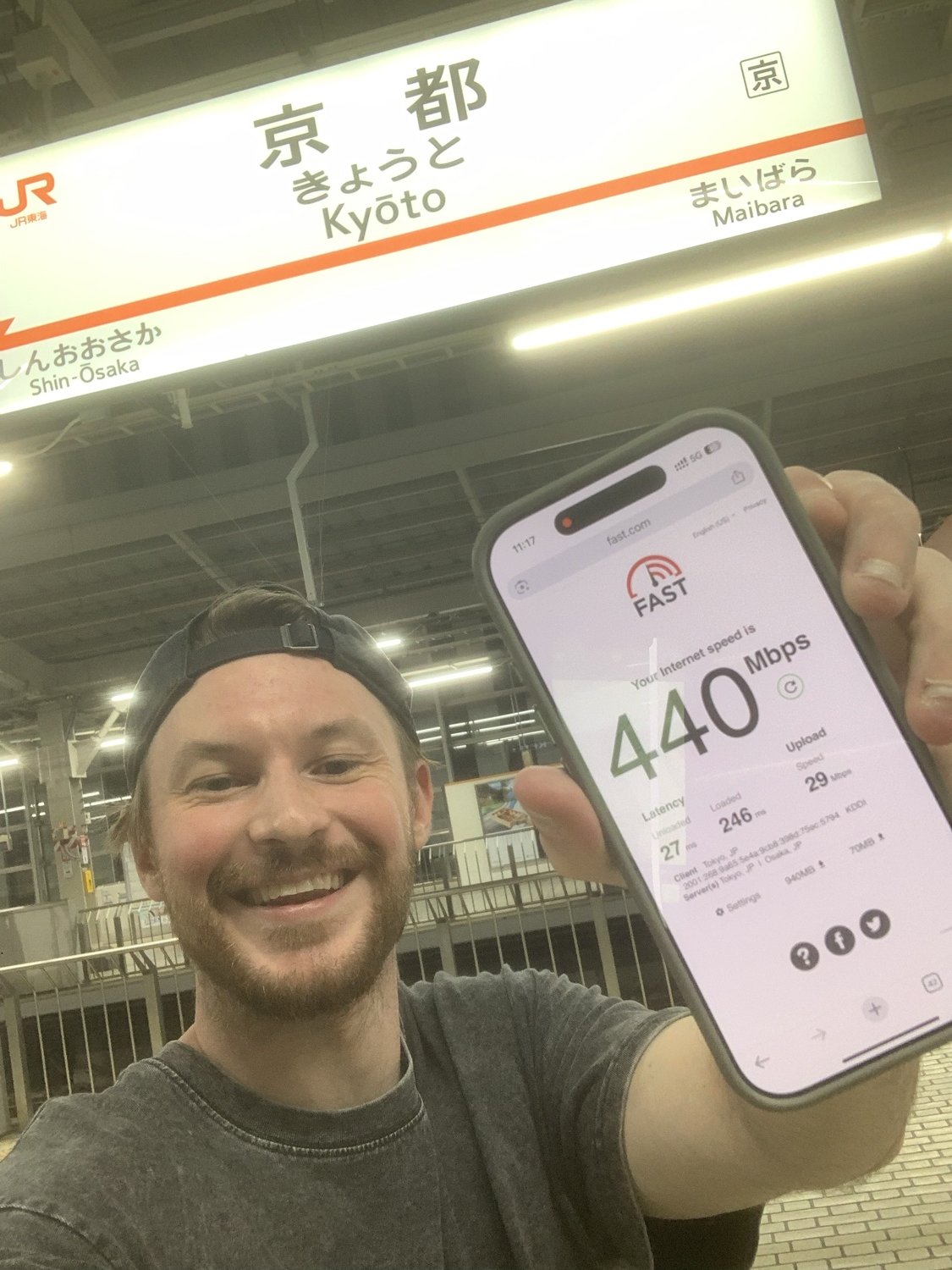
440 Mbps recorded at Kyoto Station
eSIM | Average, best 3 (Mbps) | Best (Mbps) | Upload (Mbps) | Latency (ms) | Reliability |
|---|---|---|---|---|---|
JJESIM | 277 | 440 | 21 | 26 | Strong |
Mobal | 163 | 190 | 29 | 23 | Strong |
Sakura | 52 | 54 | 14 | 32 | Stable |
Saily | 157 | 200 | 16 | 29 | Dropped 1x |
Airalo | 20 | 21 | 6 | 89 | Stable |
Holafly | 8 | 10 | 7 | 123 | Weak |
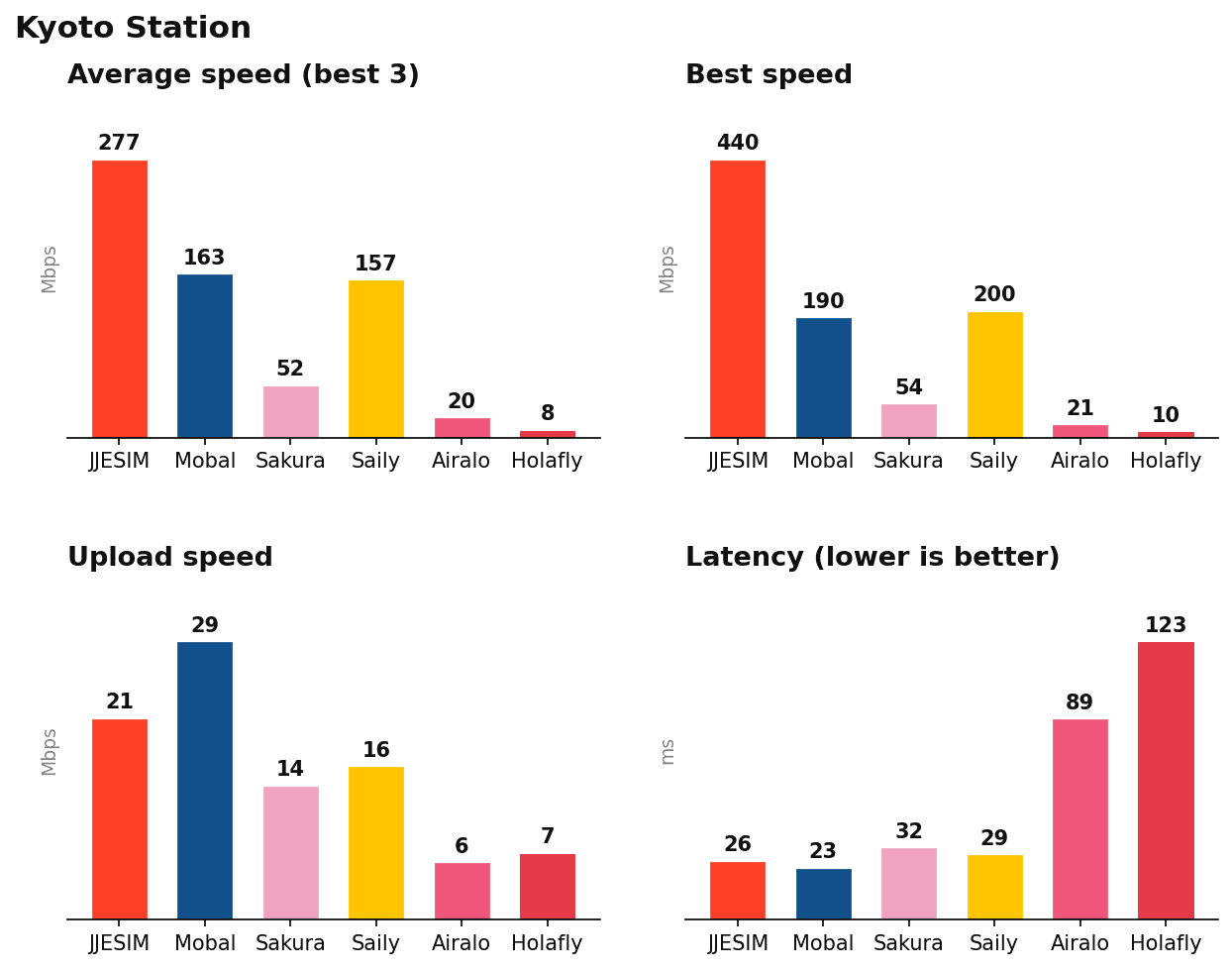
Kyoto Station: download, upload, latency and reliability by provider
Journey Japan averaged 277 Mbps with a best of 440. Mobal averaged 163 and Saily 157, with Saily dropping one test. Sakura Mobile reached 54 Mbps, its highest result anywhere on the trip. Airalo returned 21 Mbps and Holafly 10.
Kinkaku-ji (Golden Pavilion)
Network: 5G / LTE
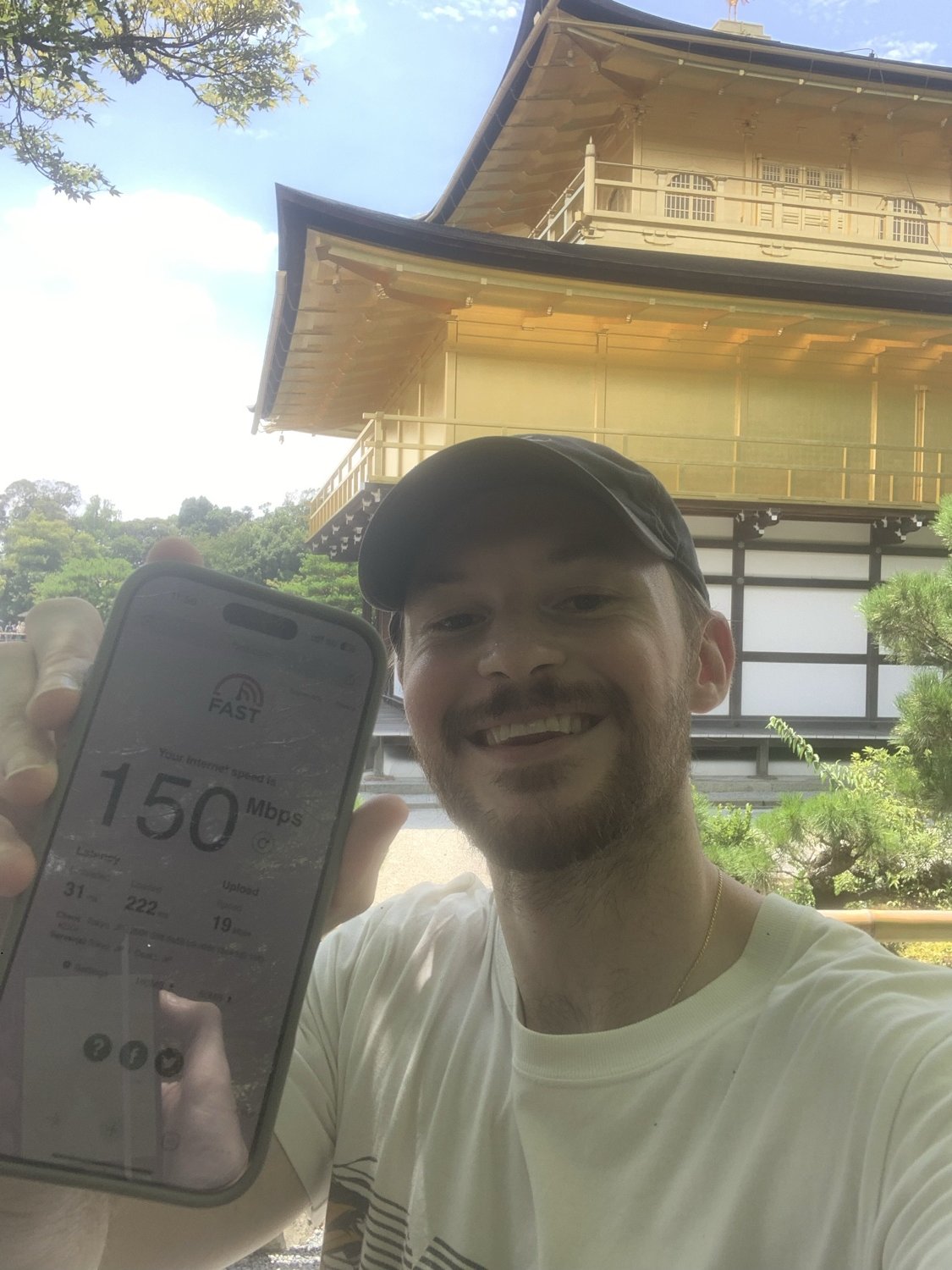
Speed test recorded at Kinkaku-ji (Golden Pavilion)
One of Kyoto's most visited temples, sitting northwest of the city centre. Open gardens with clear sky overhead, but a single viewing path that concentrates every visitor into the same few metres at midday.
eSIM | Average, best 3 (Mbps) | Best (Mbps) | Upload (Mbps) | Latency (ms) | Reliability |
|---|---|---|---|---|---|
JJESIM | 140 | 150 | 18 | 30 | Strong |
Mobal | 42 | 47 | 17 | 27 | Stable |
Sakura | 20 | 21 | 6 | 66 | Stable |
Saily | 37 | 42 | 10 | 34 | Dropped 1x |
Airalo | 19 | 21 | 11 | 84 | Stable |
Holafly | 7 | 10 | 9 | 113 | Weak |
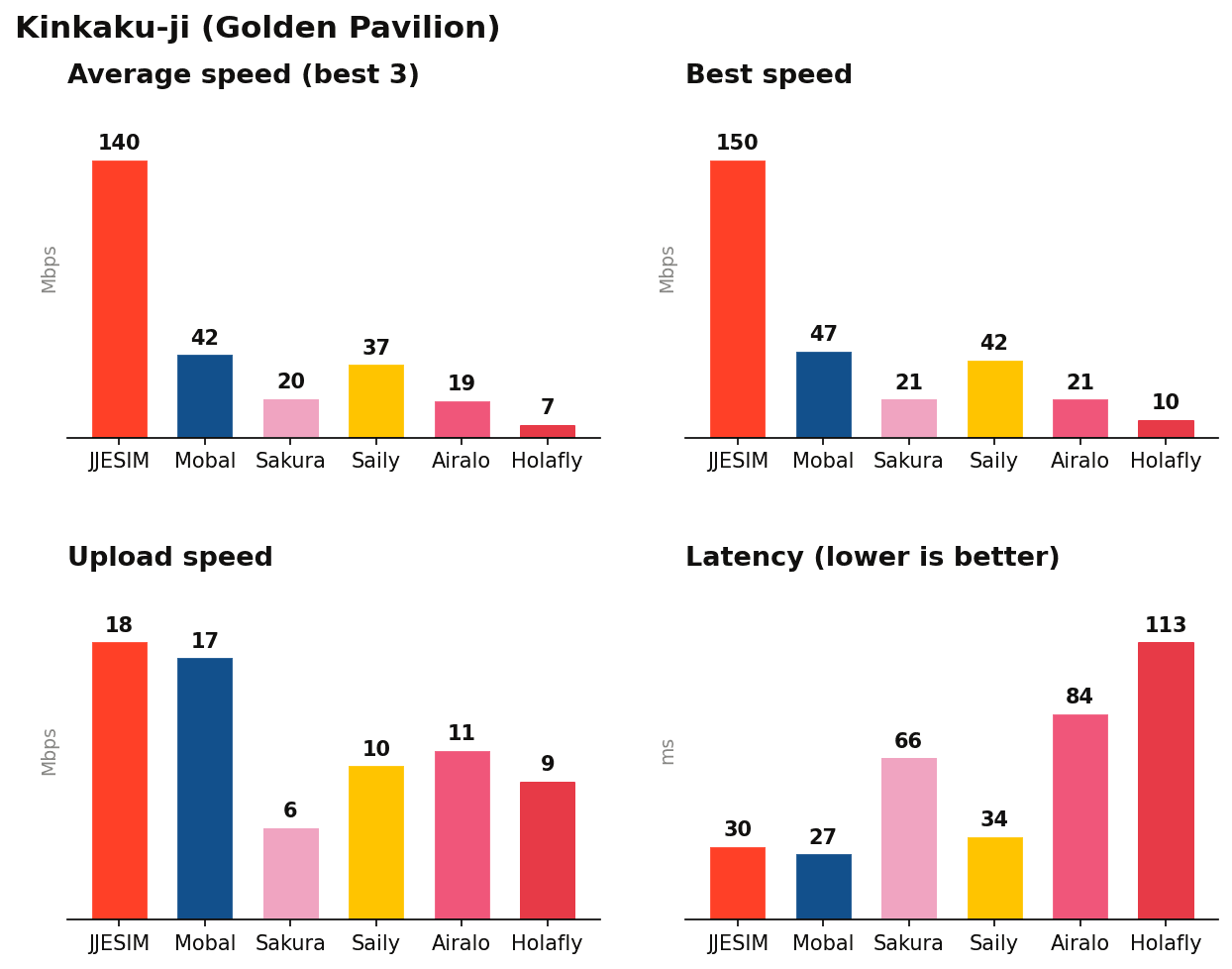
Kinkaku-ji (Golden Pavilion): download, upload, latency and reliability by provider
Journey Japan averaged 140 Mbps with a best of 150. Mobal averaged 42 Mbps, Saily 37 with one dropped test, Sakura Mobile 20 and Airalo 19. Holafly averaged 7 Mbps at 113 ms latency.
Arashiyama Bamboo Grove
Network: 5G / LTE / 4G
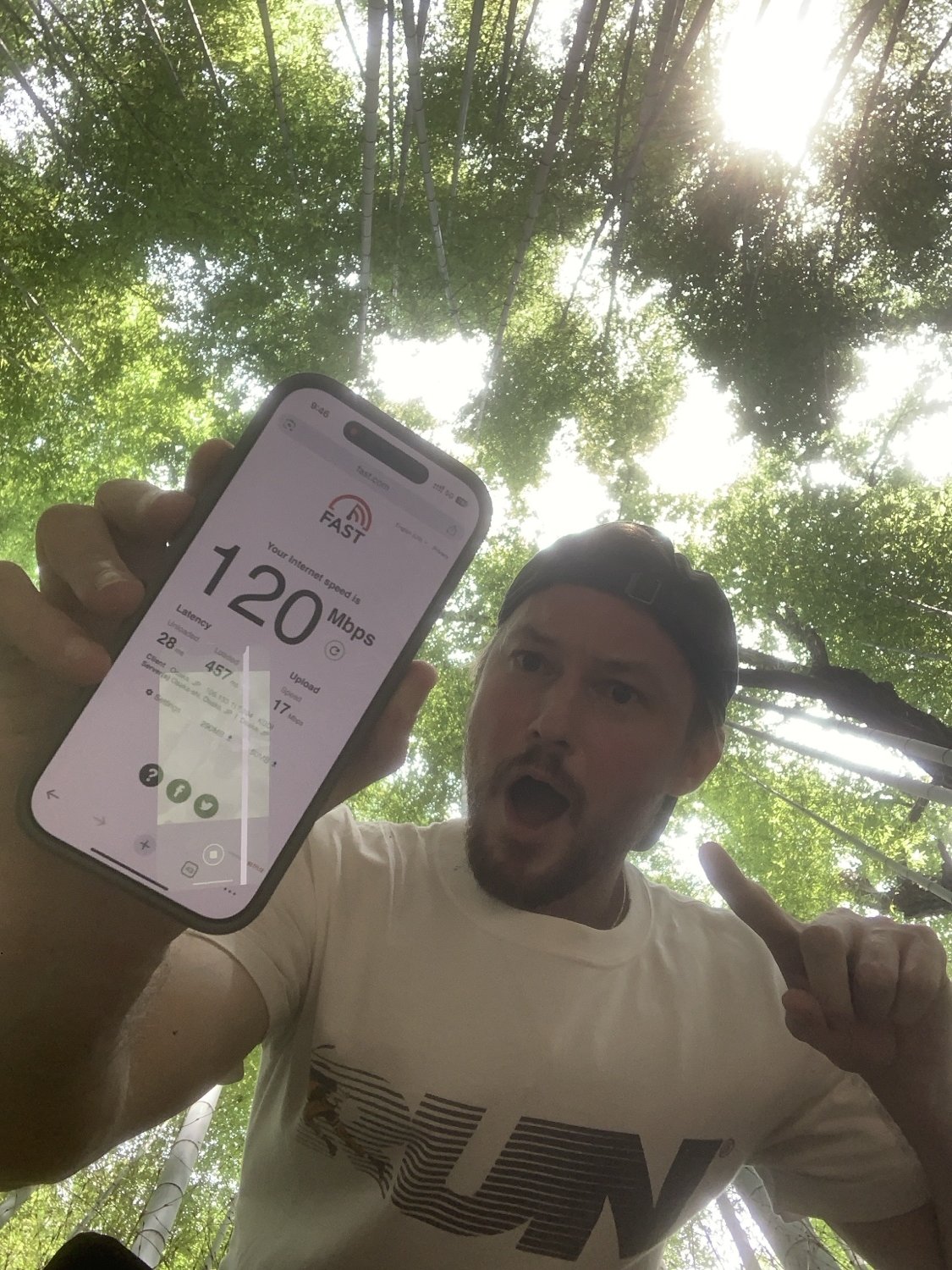
Speed test recorded at Arashiyama Bamboo Grove
The bamboo grove on Kyoto's western edge, and the hardest ground we found for an eSIM to hold a signal. Dense overhead cover the length of the path, with no clear line to any nearby mast.
eSIM | Average, best 3 (Mbps) | Best (Mbps) | Upload (Mbps) | Latency (ms) | Reliability |
|---|---|---|---|---|---|
JJESIM | 68 | 120 | 17 | 28 | Strong |
Mobal | 11 | 13 | 8 | 29 | Stable |
Sakura | 6 | 8 | 8 | 40 | Weak |
Saily | 32 | 71 | 7 | 34 | Dropped 1x |
Airalo | 13 | 20 | 8 | 78 | Stable |
Holafly | 8 | 8 | 7 | 126 | Weak |
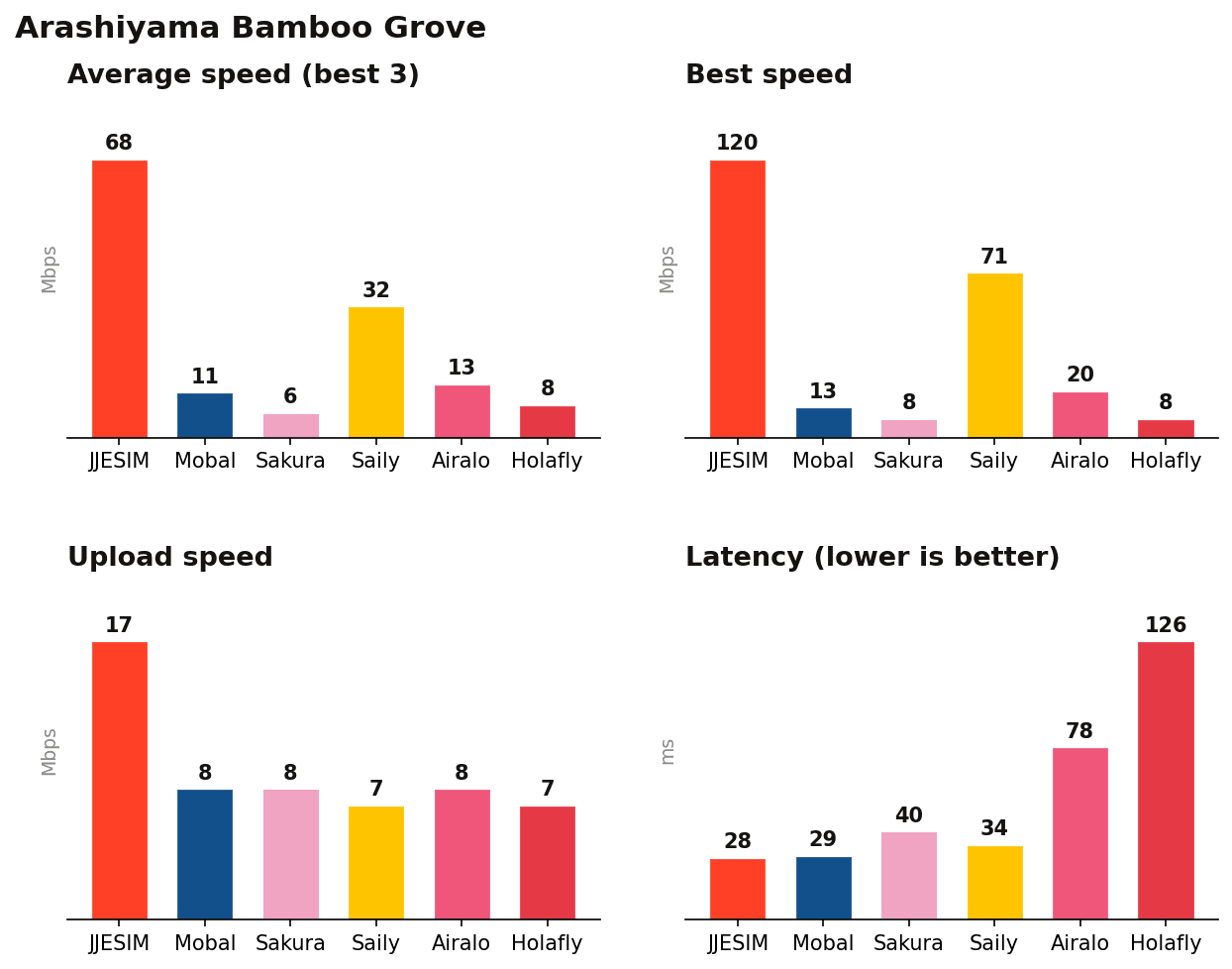
Arashiyama Bamboo Grove: download, upload, latency and reliability by provider
Speeds fell across every provider at this location. Journey Japan averaged 68 Mbps with a best of 120. Saily reached 71 Mbps on one run but averaged 32 and dropped a test. Airalo averaged 13 Mbps, Mobal 11, Holafly 8 and Sakura Mobile 6.
Kiyomizu-dera
Network: 5G / LTE
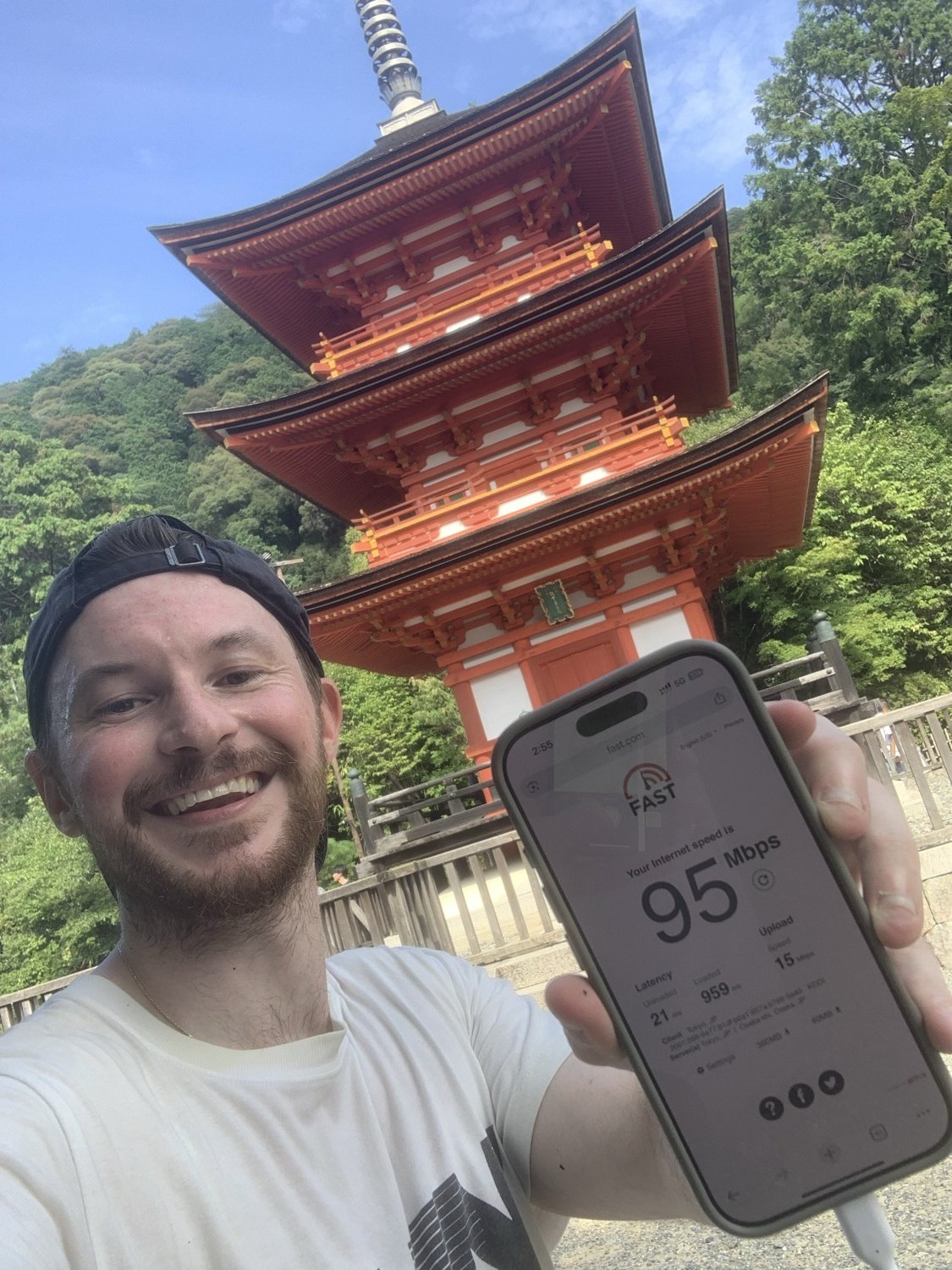
Speed test recorded at Kiyomizu-dera
A hillside temple on the eastern edge of the city, reached by a steep climb through narrow approach streets. Elevation, close-packed buildings and constant foot traffic all in one place.
eSIM | Average, best 3 (Mbps) | Best (Mbps) | Upload (Mbps) | Latency (ms) | Reliability |
|---|---|---|---|---|---|
JJESIM | 71 | 95 | 27 | 23 | Strong |
Mobal | 31 | 64 | 14 | 24 | Stable |
Sakura | 18 | 23 | 19 | 35 | Stable |
Saily | 55 | 99 | 11 | 42 | Stable |
Airalo | 18 | 21 | 13 | 83 | Stable |
Holafly | 7 | 9 | 8 | 132 | Weak |
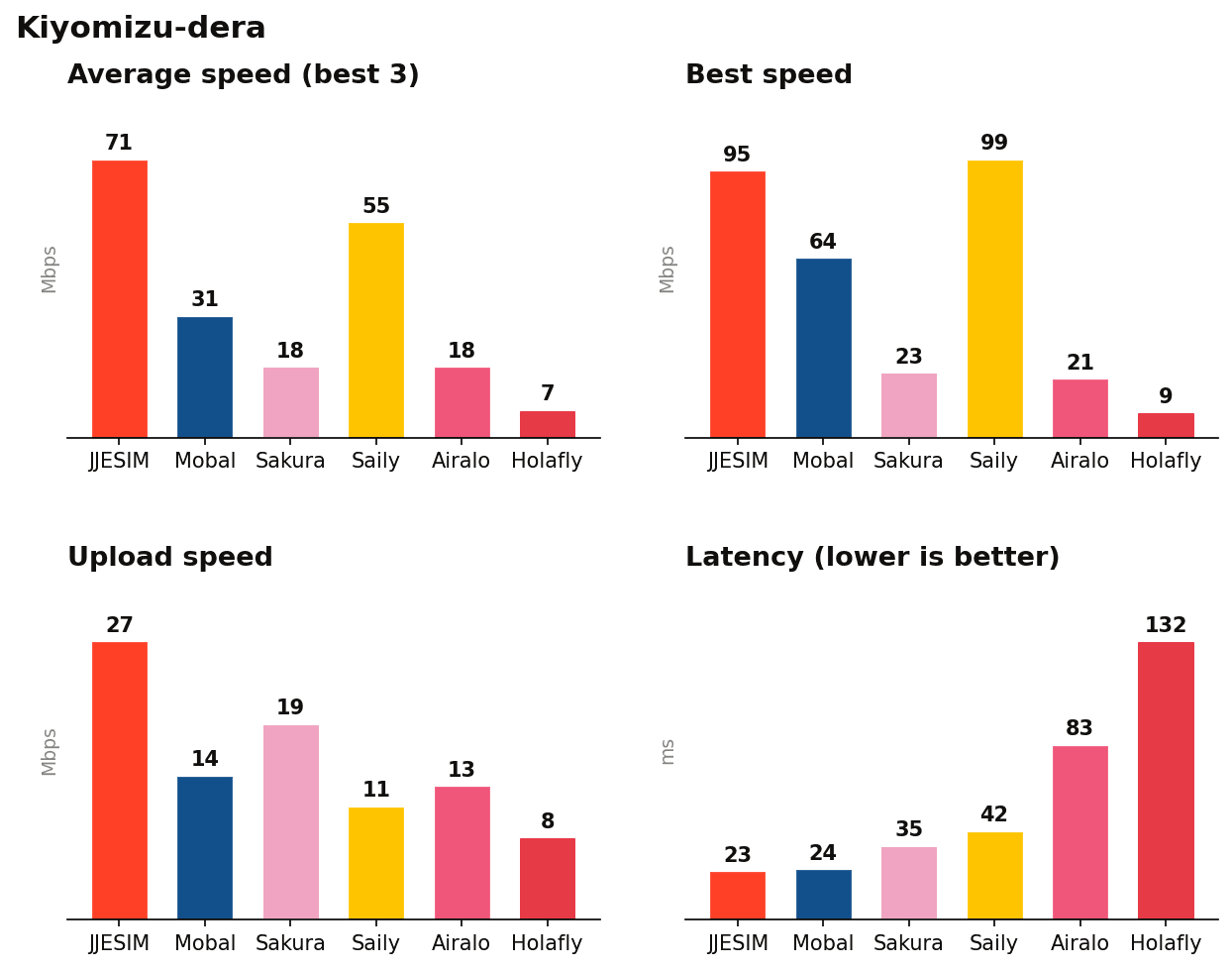
Kiyomizu-dera: download, upload, latency and reliability by provider
Saily recorded the highest single result at this location, 99 Mbps, just ahead of Journey Japan at 95. On best-three averages Journey Japan led at 71 Mbps to Saily's 55. Mobal averaged 31 Mbps, Sakura Mobile 18, Airalo 18 and Holafly 7.
Fushimi Inari
Network: 5G
Speed test recorded at Fushimi Inari
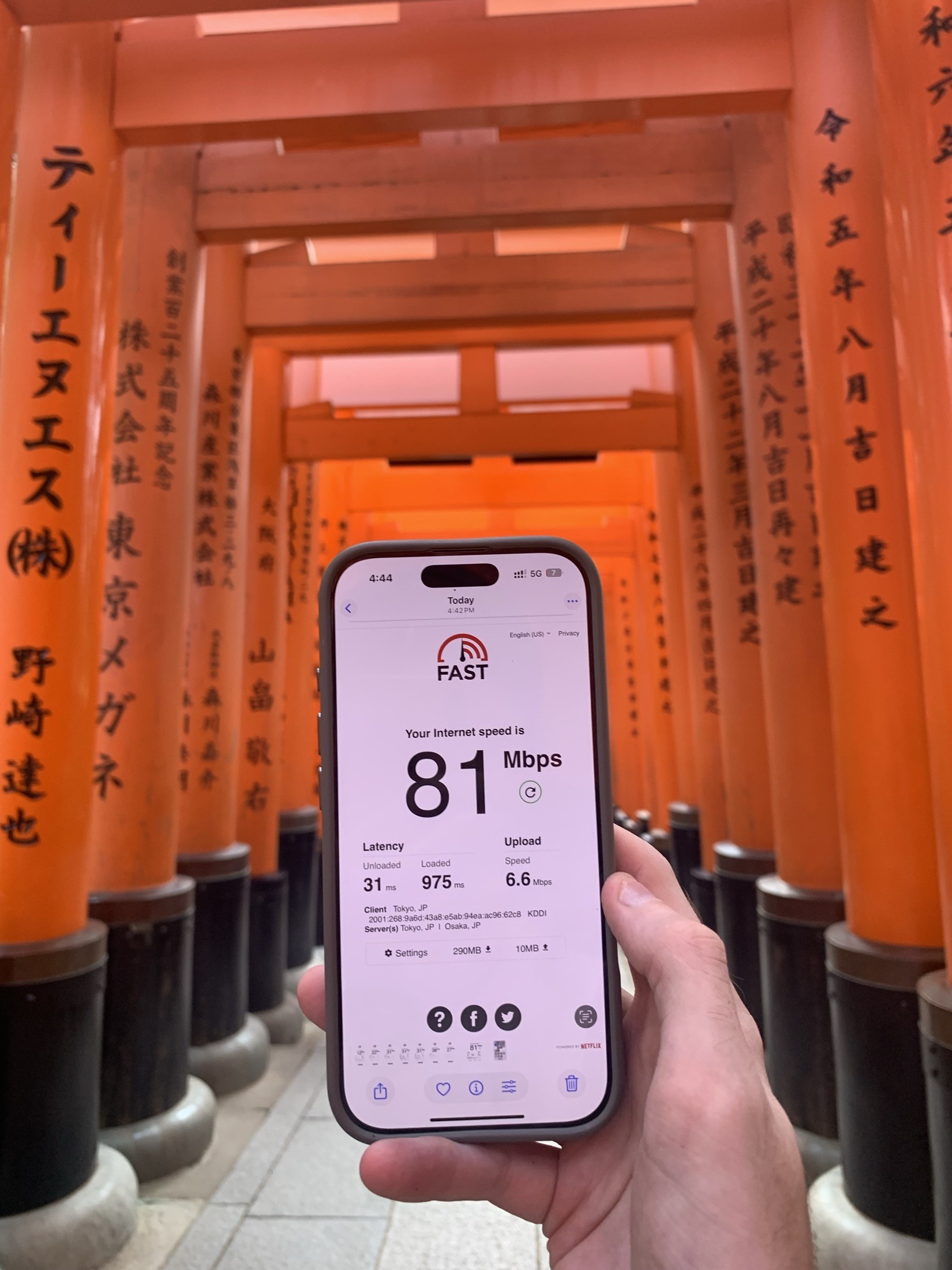
The mountain shrine known for its torii gate path. Tested on the climb itself rather than at the entrance, where the route rises into the hillside and the signal thins with elevation.
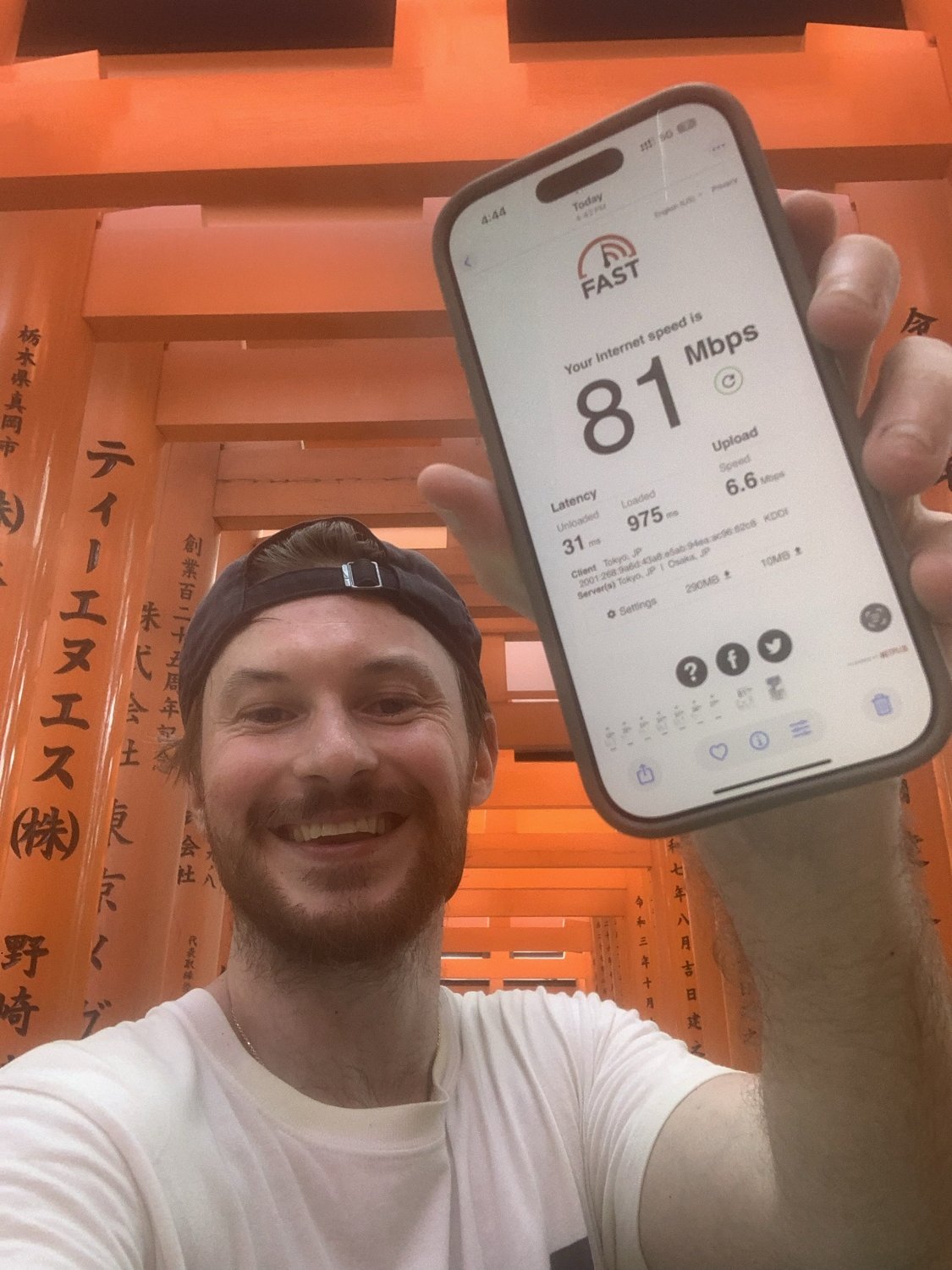
81 Mbps recorded at Fushimi Inari
eSIM | Average, best 3 (Mbps) | Best (Mbps) | Upload (Mbps) | Latency (ms) | Reliability |
|---|---|---|---|---|---|
JJESIM | 50 | 81 | 10 | 29 | Strong |
Mobal | 22 | 31 | 7 | 28 | Stable |
Sakura | 6 | 11 | 6 | 71 | Weak |
Saily | 17 | 21 | 2 | 13 | Stable |
Airalo | 20 | 21 | 6 | 86 | Stable |
Holafly | 9 | 10 | 5 | 122 | Weak |
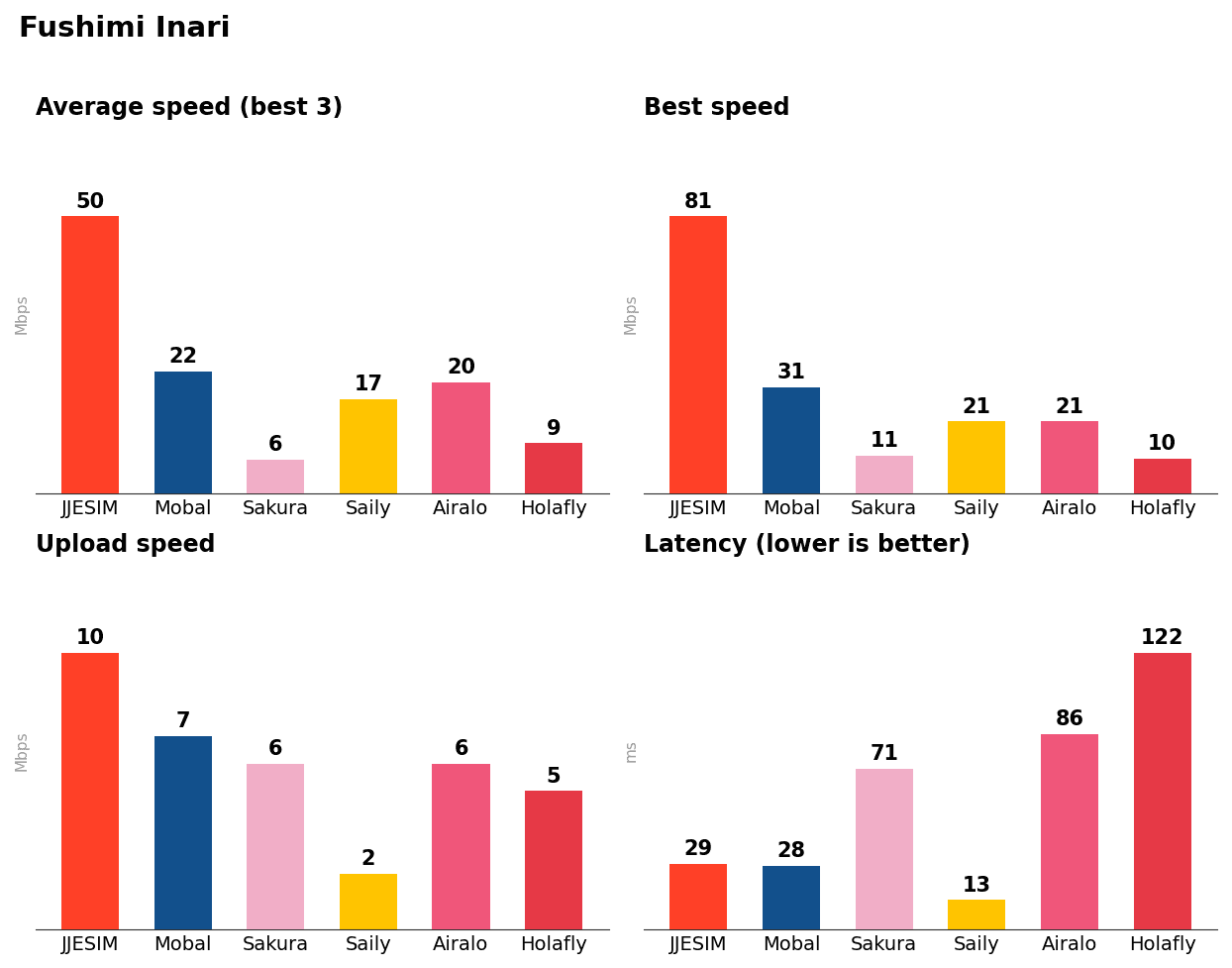
Fushimi Inari: download, upload, latency and reliability by provider
Journey Japan's figures here cover the climb only; readings taken at the front gate are excluded. On the climb it averaged 50 Mbps with a best of 81. Mobal averaged 22 Mbps, Airalo 20, Saily 17, Holafly 9 and Sakura Mobile 6.
Tokyo
Tokyo speed tests are being gathered and will be reflected here soon, with a more in-depth breakdown of the individual locations.
Other places in Japan
Speeds change the moment you start moving. This section covers everywhere that is not a city centre, from travelling between cities on the Shinkansen to underground stations and one-off spots, with more added as we test them.
Tokaido Shinkansen, in motion
Network: 5G / LTE
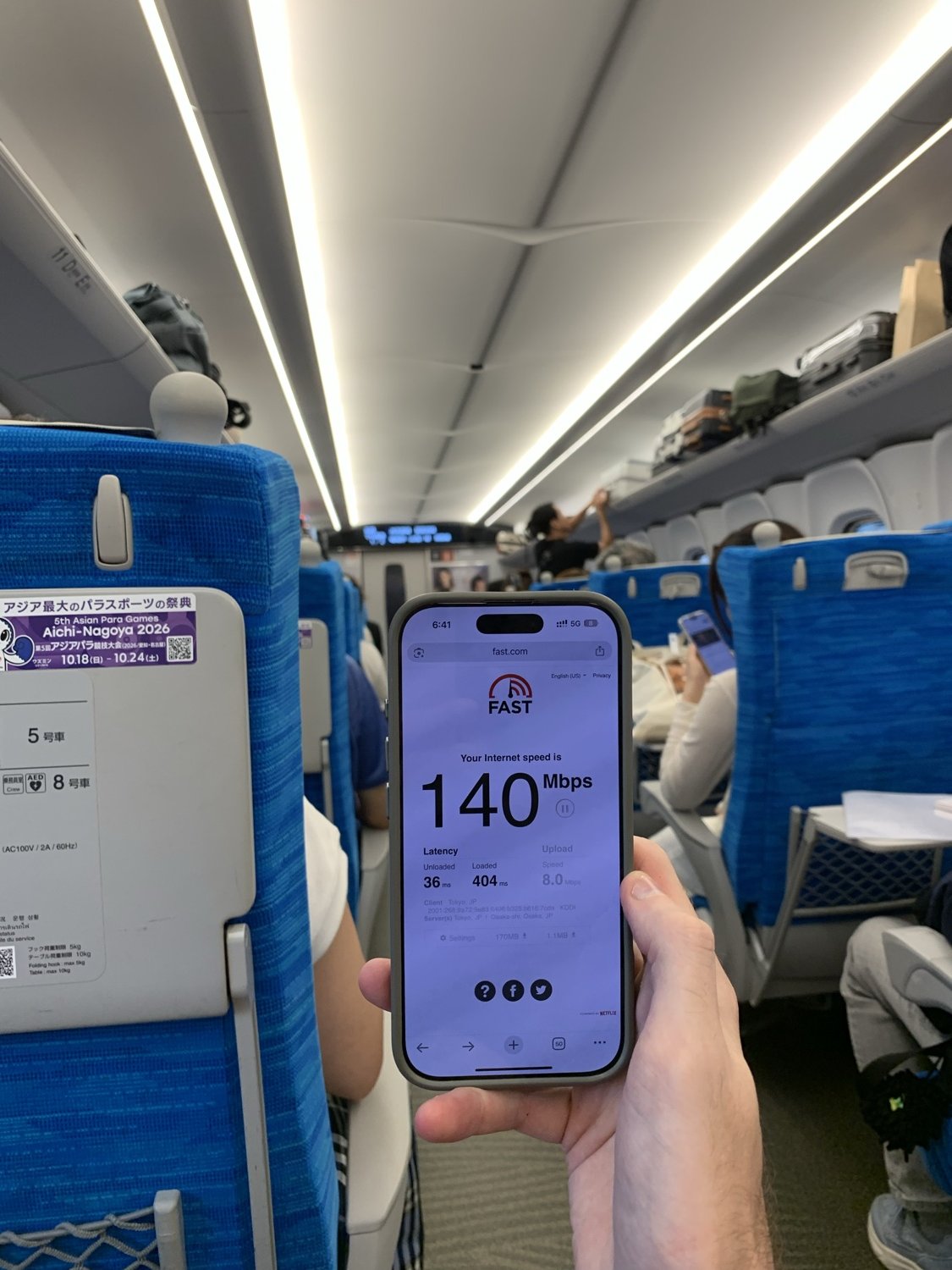
Speed test recorded at Tokaido Shinkansen, in motion
Recorded on board at roughly 300 km/h through open countryside. The handset hands off between masts constantly at this speed, which is the toughest test of a connection holding rather than peaking.
eSIM | Average, best 3 (Mbps) | Best (Mbps) | Upload (Mbps) | Latency (ms) | Reliability |
|---|---|---|---|---|---|
JJESIM | 112 | 170 | 18 | 30 | Strong |
Mobal | 10 | 15 | 5 | 34 | Stable |
Sakura | 5 | 8 | 12 | 59 | Weak |
Saily | 6 | 8 | 7 | 40 | Weak |
Airalo | 6 | 8 | 6 | 89 | Weak |
Holafly | 3 | 6 | 2 | 115 | Weak |
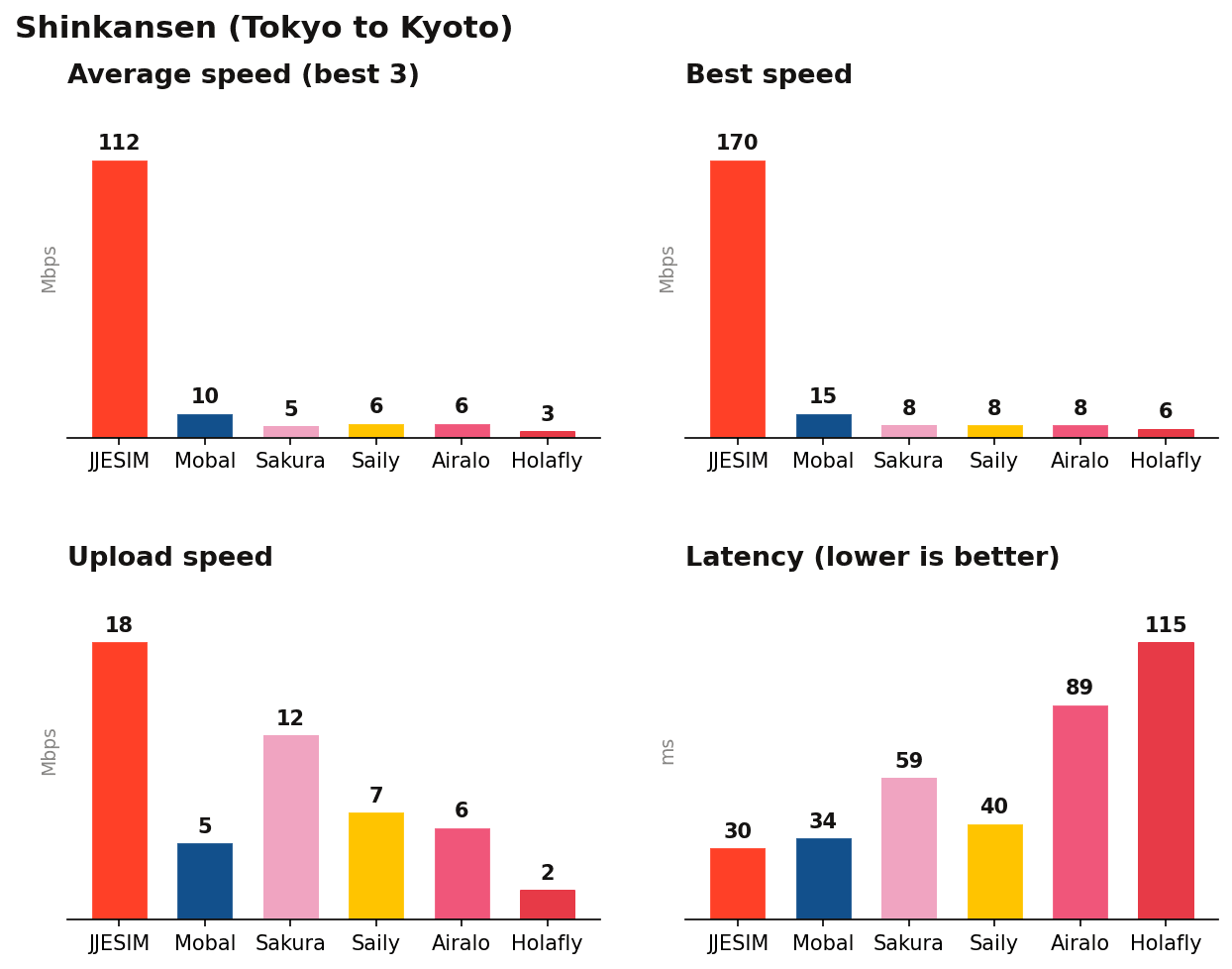
Tokaido Shinkansen, in motion: download, upload, latency and reliability by provider
Results vary second to second at this speed and should be read as directional. Journey Japan averaged 112 Mbps with a best of 170. Every other provider averaged 10 Mbps or below: Mobal 10, Saily 6, Airalo 6, Sakura Mobile 5 and Holafly 3.
What the results show so far
Across every location tested, the pattern has been consistent. Speeds in Japan are high almost everywhere on a local network, and the gap between providers is narrow in city centres and much wider everywhere else.
Journey Japan and Mobal, both routed inside Japan, held their speeds at the temples, along the bamboo grove path and on a train at 300 km/h. Saily recorded the fastest single run at two of the locations tested and failed to connect at six others. Airalo and Holafly stayed slow but steady throughout.
How to use this database before buying an eSIM
Use this database when you are comparing Japan eSIMs and want more than a price and a data allowance. If you already have a provider in mind, you can look up how it actually performed in the places you plan to visit.
Performance always depends on the local network, the time of day and how busy an area is, so treat these as recorded results rather than guarantees. What they show is how each provider behaved under the same conditions, in the same places, on the same day.
How we tested
Every eSIM was given a fair and equal run. The same device, the same app, the same spot and the same conditions, one provider after another, on unlimited plans wherever a provider offered one.
A single speed test can swing dramatically, so each provider was recorded as a three-test average at every location rather than a single reading. Further tests were run wherever results were inconsistent or an eSIM could not connect confidently.
Testing is done on current, up to date hardware, such as an iPhone 16 Pro running the latest iOS, using Fast.com for every run so the measurement is identical across providers. Each test was filmed as it happened, showing the speed, the network type and the location in a single frame. Where a provider could not complete a test, it was recorded as a failure.
What the numbers mean
Three figures come up in every speed test, and they are the ones normally used to judge whether a connection is genuinely strong or merely adequate.
Download speed
Download speed is the headline number, and fairly so. It is the one that affects what you notice first: loading maps, opening apps, browsing, streaming and scrolling social media. It is measured in megabits per second, and a higher number means content arrives faster.
Upload speed
Upload speed is how fast data leaves your phone, and it is the figure most people ignore until it causes a problem. It matters if you:
Make video calls
Upload photos or video to social media or email
Send large files
Post content while travelling
Rely on cloud backups
Download speed gets the attention, but upload supports all of it. An eSIM with a strong download figure and a weak upload can still feel underwhelming if you depend on calls, content or remote work, and upload tends to be the harder of the two for a network to deliver.
Latency
Latency is the delay between your phone asking for something and the network answering, measured in milliseconds. Unlike speed, lower is better. It is what decides whether a map redraws the moment you move, whether a video call holds a conversation, and whether a page feels instant or laggy. A connection can post a high download figure and still feel slow if its latency is poor.
What we also pay attention to
Alongside the headline numbers, these are the things we watch on every test, because they explain results that the speed figure alone does not.
Where the traffic is routed
Two eSIMs can show the same signal bars and behave very differently depending on which Japanese network they connect to and where their traffic is handled once it leaves the phone.
eSIM | Japanese network used | Traffic routing |
|---|---|---|
Journey Japan eSIM | KDDI (au) and NTT Docomo | Local, inside Japan |
Mobal | NTT Docomo and KDDI (au) | Local, inside Japan |
Sakura Mobile | NTT Docomo and KDDI (au) | Local, inside Japan |
Airalo | SoftBank | Routed outside Japan |
Holafly | KDDI and SoftBank | Routed outside Japan |
Saily | Not published | Routed outside Japan |
Every run on Journey Japan, Mobal and Sakura Mobile stayed inside Japan. Every run on Airalo, Holafly and Saily was routed abroad, which is the most likely reason those three also recorded the highest latency.
4G, 5G and the connection type
Our advice is not to take a 5G badge at face value. Several providers showed 5G in the status bar across these tests and returned wildly different results, from over 900 Mbps down to under 1. The label tells you which network type the phone attached to, not the quality of the connection behind it. A congested 5G cell can easily lose to a clear 4G one, which is why every entry here records the connection type alongside the figure.
Whether a provider holds up across networks and locations
A provider that posts one strong number is less useful than one that holds up everywhere. We record how each eSIM performed across different networks and locations rather than only its best result, which is why a failed connection counts against a provider even when its peak was high.
How the connection actually feels to use
Numbers do not capture everything. We also note how a connection behaved in normal use: whether maps redrew the moment we moved, whether pages stalled, and whether the signal held when walking between areas or boarding a train.
Final thoughts
Most Japan eSIM comparisons give you a price and a data allowance and stop there. Very few show what the connection actually does once you land and start moving around the country.
Based on everything recorded so far, Journey Japan eSIM has delivered the strongest speeds, the most consistent connection and the lowest latency of the Japan eSIMs tested. It also runs on true unlimited data, with no throttling and no daily cap, so the speeds in these tables are what you keep for the length of your trip rather than what you get until an allowance runs out.
Testing continues, and this page is updated as new locations and providers are recorded.