Posted on
/
By
Clay Thomas
From the Author: "I am an avid cruise enjoyer. These are one of my favorite vacation types. I try to convince many of my friend to book a cruise, not only in Japan, but any time they are looking for an amazing vacation. I am thrilled to mix my expertise and knowledge to help out those who truly need guidance with their data while cruising Japan."
First, Japan cruise data is something most travelers don't think about until they're already on the ship, staring at a roaming charge notification they didn't see coming. If you've booked a cruise that stops in Japan, knowing how connectivity works before you board can save you a lot of stress and a surprisingly large phone bill.
This guide breaks down exactly what happens to your phone signal at sea, what your real options are, and how to stay connected at every Japan port stop without overpaying.
Why Connectivity on a Japan Cruise Works Differently
A Japan cruise isn't like a regular trip where you land at an airport and activate your data plan. You're moving between open ocean and land, sometimes daily. That shift changes everything about how your phone connects to the internet, and treating it like a standard international trip is where most people go wrong.
What Happens to Your Phone Signal at Sea
When your ship is close to shore, your phone behaves normally. It picks up land-based cell towers and connects just like it would in any city.
Once the ship moves of the mainland and on it's normal journey, those land towers disappear. Your phone starts searching for any available network. You might find options labeled "Cellular at Sea," "WMS at Sea," or simply "901" on your screen, but these can be dangerous. Why?
That network runs on satellite technology. It can work, but it's a premium service. Most major carriers treat it as international maritime roaming and bill accordingly, often $3 to $5 per minute for calls and even $1 of more for a single text. That is pricey data. Additionally. if you aren't careful, background app syncing alone can rack up charges without you ever actively using your phone. Imagine paying for $100 a day for just having your phone in your pocket. No, thank you. However, that's when a Japan eSIM can become genuinely useful.
Your Data Options While Sailing at Sea
On sea days, your choices are quite limited but manageable if you know what they are going in.
Onboard Ship Wi-Fi Packages
Most cruise lines sell Wi-Fi packages you purchase through the ship. Pricing typically ranges from $15 to $35 per day depending on the cruise line and plan tier. Higher tiers support streaming and video calls. Basic tiers cover messaging and email.
Many modern ships have upgraded to Starlink or similar low-earth orbit satellite systems, which means speeds are noticeably better than they used to be. It's still slower than land-based broadband, but usable for most everyday tasks.
If you know you'll need to stay connected during sea days, buying a ship Wi-Fi package in advance usually gets you a better rate than purchasing onboard.
Maritime Cellular Networks and Their Hidden Costs
As shared above, saving your phone's data roaming on at sea is the most common and most expensive mistake cruisers make. Your phone connects to maritime networks automatically. You don't have to do anything, and the charges start quietly in the background.
Even if you have an "unlimited" international plan at home, those plans almost never cover maritime networks. The rules are different at sea, and your carrier will bill you separately for it.
The safest move is to turn on airplane mode the moment you leave port and only switch back when you arrive at the next destination.
Why Standard eSIMs Don't Work Mid-Ocean
A standard Japan eSIM, or any regional travel eSIM, connects to land-based cellular towers. There are no land towers in the middle of the Pacific. Once you're out at sea, your eSIM has nothing to connect to.
This isn't a flaw in the product. It's just physics. An eSIM is the right tool for port connectivity. Ship Wi-Fi is the right tool for sea days. Using both together is the smart approach.
Japan Cruise Data Coverage at Port
This is where a Japan eSIM genuinely earns its place. Port days are often your most data-intensive, with maps, translations, restaurant searches, and photos all happening at once.
Which Japanese Port Cities Your Cruise Likely Visits
Japan cruise itineraries commonly include Yokohama (the gateway to Tokyo), Osaka, Kobe, Nagasaki, Kagoshima, Hiroshima via Kure, and Naha in Okinawa. Some routes also call at Shimizu, Beppu, or Otaru in Hokkaido.
Every single one of these cities has strong, reliable 4G and 5G mobile coverage. Japan's network infrastructure is among the best in the world, which means a Japan eSIM connected to a top-tier network will perform well in all of them.
How Fast Japan's Mobile Networks Are on Land
Japan regularly ranks among the top countries globally for mobile network performance. 4G LTE is available virtually everywhere in urban areas, and 5G coverage is rapidly expanding across major cities.
In practical terms, you can expect fast enough speeds for Google Maps, real-time translation apps, video calls, and uploading photos without any lag. It's a significant jump from the slower, often inconsistent speeds you get on ship Wi-Fi.
Japan Cruise Data With an eSIM in Port
A Japan eSIM running on a premium network, like NTT Docomo's infrastructure, connects the moment you step off the gangway. No SIM swapping, no hunting for a local shop, no language barriers at a mobile store.
You get the same network quality a local resident uses. That means fast, stable data in port cities, coastal towns, and anywhere else your shore excursion takes you.
This is what makes Japan cruise data planning so straightforward when you use a Japan-specific eSIM. One plan, every port, full coverage.
The Smart Connectivity Strategy for Japan Cruises
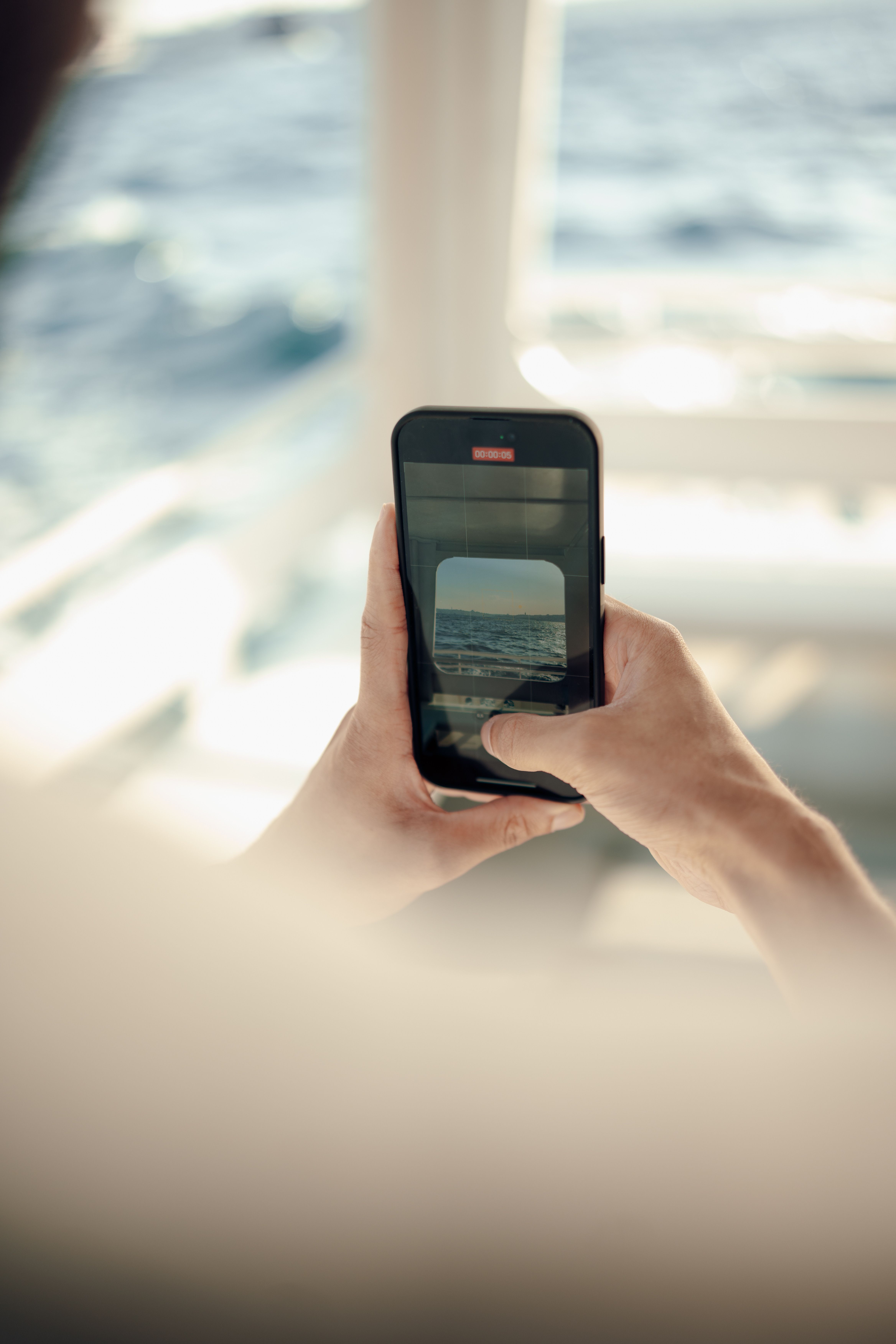
Now that you understand how the data options, here's the practical plan that most experienced cruisers follow.
Airplane Mode at Sea, eSIM near Shore and Port
As soon as your ship leaves a port, enable airplane mode. Keep Wi-Fi on within airplane mode so you can connect to the ship's onboard Wi-Fi without triggering maritime roaming on your home SIM.
When arrive at a Japanese port, disable airplane mode and let your eSIM connect to the local network. Browse, navigate, and communicate freely. Before the ship departs, switch back to airplane mode.
This two-step habit takes about five seconds and eliminates the risk of accidental maritime charges entirely.
Setting Up Your eSIM Before You Board
Install and activate your Japan eSIM before you leave home. The process takes a few minutes and requires a stable Wi-Fi connection and a compatible, unlocked device.
Having it ready in advance means zero setup time when you're onboard relaxing, or standing at a port with a few hours to explore. You step off, you're connected.
If your device isn't eSIM compatible, check a compatibility list before purchasing. Most modern smartphones from 2019 onward support eSIM, but it's worth confirming your specific model.
How Much Data You Actually Need Per Port Day
For light use, meaning maps, messaging, and occasional web searches, you'll use roughly 0.3 to 0.6 GB per port day. If you're posting to social media, sharing photos, or using translation apps heavily, budget 0.8 to 1.5 GB per day.
For a typical 10 to 14 day Japan cruise with 6 to 8 port days, a 10GB to 20GB plan covers most travelers comfortably. Heavy users or those who want a buffer for the whole trip will find a 30GB to 50GB plan more appropriate.
Choosing the Right Japan Cruise Data Plan
The right plan depends on your itinerary length, how many port days you have, and how actively you use your phone when you're ashore.
Matching Plan Size to Your Itinerary
Short cruises of 7 to 10 days with 4 to 5 port stops can usually get by with a 10GB or 20GB plan. Longer itineraries of two weeks or more, especially round-trip cruises covering multiple Japanese cities, benefit from 50GB or higher.
When in doubt, go slightly larger. Unused data doesn't cost you anything on the ground, but running out mid-trip means scrambling for a solution at a foreign port. Additionally, if you are traveling all around Japan, staying close to shore, you Japan eSIM can still pick up signal to access stronger networks, and use your available data.
eSIM vs. Pocket Wi-Fi for Japan Cruises
Pocket Wi-Fi devices have been a popular option for Japan travelers for years. They're standalone devices that create a local Wi-Fi hotspot and can connect multiple devices at once.
For cruise travel specifically, eSIM is overall the better fit. Pocket Wi-Fi requires a physical pickup and return (usually at an airport), adds another device to carry and charge, and is another thing to keep track of when getting on and off the ship. If you leave your Pocket Wi-Fi on shore after you dock, that there gos your connection and a extra $300 down the drain for returns. Ultimately it is worse at sea than an eSIM. An eSIM lives on your phone, activates instantly, requires nothing extra, and can't be lost.
What to Look For in a Japan eSIM
Not all eSIMs are the same. For a Japan cruise, prioritize these factors.
Network quality matters most. Look for a plan that runs on Japan's top-tier networks, specifically one with 99% or near-nationwide coverage. A plan tied to a premium network performs reliably not just in Tokyo and Osaka, but in smaller port towns too.
Plan validity should cover your full trip. Most Japan eSIM plans are sold in 10, 15, or 30 day windows. Match it to cover your travel dates, including any pre or post cruise days in Japan.
Activation should be instant and fully digital, with no physical SIM required and no need to be in Japan first. You should be able to install and set up everything from home before you depart.
Conclusion
Japan cruise data planning comes down to one core idea: two zones, two tools. Ship Wi-Fi handles your sea days. A Japan eSIM handles your port days, and even when you are near the coastline. Using both together means you stay connected throughout the trip without overpaying for maritime roaming or scrambling for a solution once you're already abroad.
Set up your eSIM before you leave home, make airplane mode a habit when leaving port, and you'll have reliable connectivity at every Japanese destination on your itinerary. If you're getting ready for a Japan cruise, getting your Japan cruise data plan sorted before you board is the one prep step that pays off every single time.
Frequently Asked Questions
1. Does a Japan eSIM work on a cruise ship?
A Japan eSIM works when your ship is docked, close to the Japanese coastline, or near port and within range of land-based cell towers. It does not work out in open ocean waters because eSIMs rely on terrestrial mobile networks, not satellite connections.
2. Do I need data roaming on a Japan cruise?
You do not need to pay for maritime data roaming if you use airplane mode at sea and a Japan eSIM in port. Enabling roaming on your home SIM at sea connects you to expensive maritime satellite networks. Keeping airplane mode on at sea avoids this entirely.
3. What network does a Japan eSIM use in port?
A quality Japan eSIM connects to one of Japan's major carrier networks at port. Plans running on NTT Docomo's infrastructure provide 4G LTE and 5G coverage across Japan's cities and coastal areas, including all major cruise port destinations.
4. Can I use my eSIM in multiple Japan ports on one plan?
Yes. A single Japan eSIM plan works at every port city in Japan on the same itinerary. Osaka, Nagasaki, Yokohama, Naha, and anywhere else covered by the underlying network are all included. You don't need separate plans for each stop.
5. Should I buy ship Wi-Fi and a Japan eSIM, or just one?
Both serve different purposes. Ship Wi-Fi covers sea days when land networks aren't available. A Japan eSIM covers port days with faster, more reliable, and more affordable data than maritime or roaming options. Using both together gives you the most complete coverage for the lowest overall cost.