Publicado en
4 min
leer
/
Por
Clay Thomas
Figuring out your Japan travel WiFi situation before you land is one of those things that sounds simple until you're standing at the airport trying to pull up Google Maps with zero signal. It happens more than you'd think.
Japan doesn't have the kind of widespread, reliable public WiFi that most travelers expect, and relying on your home carrier's roaming plan can quietly rack up charges you won't notice until you're back home and opening your bill.
The good news is that there are two solid options built specifically for travelers: pocket WiFi and eSIM. Both work well. The one that's right for you depends on how you travel.
Why Your Internet Choice Matters in Japan
Japan has free WiFi in many airports, some train stations, and major tourist spots, but coverage drops off quickly once you're outside those zones. Hotel WiFi is fine for the room, but it won't help you navigate between neighborhoods, look up restaurant reviews, or use translation apps on the go.
Data roaming through your home carrier is technically an option, but the costs add up fast. Even plans marketed as "international" often have daily caps, throttled speeds after a few hundred megabytes, and rates that charge "an arm and a leg" for kilobyte in the background.
For a real, usable connection throughout your trip, pocket WiFi and eSIM are the two options worth looking at seriously.
What Is Pocket WiFi and How Does It Work
Pocket WiFi is a small, portable device that connects to Japan's mobile network and creates a personal WiFi hotspot you can connect multiple devices to. Think of it like carrying a mini router in your pocket.
You rent one in advance through a provider, then pick it up at the airport upon arrival or have it delivered to your hotel. At the end of your trip, you return it before you fly out, usually at an airport counter or by dropping it in a postbox.
Pocket WiFi Pros
The biggest advantage is multi-device support. A single pocket WiFi unit can connect anywhere from 5 to 10 devices at once, which makes it practical for groups, families, or anyone traveling with a phone, tablet, and laptop.
There are no phone compatibility requirements either. Any device that connects to WiFi works, regardless of model, age, or carrier lock status. Setup is about as simple as it gets: turn it on, select the network name on your phone, and enter the password.
Pocket WiFi Cons
The main drawback is that it's a physical device you're responsible for throughout the trip. You need to charge it daily, keep it in range of whoever needs it, and remember to return it before you leave. Forget to charge it or leave it at the hotel, and your whole group loses connectivity.
You also need to plan ahead. Most providers require advance booking, and airport pickup means you need to find the right counter after a long flight before you can get online. If one person in your group has the device and splits off for the afternoon, everyone else loses their connection.
What Is a Japan travel WiFi eSIM and How Does It Work
A Japan travel WiFi eSIM is a digital SIM built directly into your phone. Instead of a plastic card you swap out, you activate it by scanning a QR code sent to your email after purchase. No trip to a store, no airport counter, no physical hardware at all.
Most phones released from around 2019 onward support eSIM, including iPhone XS and later, Samsung Galaxy S20 and later, and Google Pixel 3 and later. The key requirement is that your phone must be carrier-unlocked.
eSIM Pros
Activation can happen before you even board your flight. By the time you land in Japan and clear immigration, your phone is already connected. No queue, no counter, no waiting.
One underrated benefit is that your home SIM stays active in the background. Your phone runs two connections at once: your regular number for calls, texts, and bank verification codes, plus the Japan eSIM for data. That dual-connectivity is something pocket WiFi cannot replicate.
There's also nothing to carry, charge, or return. The eSIM lives in your phone and disappears when the plan ends.
eSIM Cons
The device requirement is a real filter. If your phone is older, budget-tier, or still locked to your home carrier, an eSIM won't be an option. You'll need to check compatibility before purchasing.
Each eSIM covers one device, so if you're traveling as a group, each person needs their own plan. Tethering (sharing your eSIM data with another device via hotspot) is supported by some providers but not all, so it's worth checking before you buy.
Head-to-Head Comparison
Factor | eSIM | Pocket WiFi |
|---|---|---|
Setup | Instant digital activation | Airport or hotel pickup |
Device Requirement | eSIM-compatible, unlocked phone | |
Multi-device | One device per eSIM, sharing capabilities | Yes, up to about 5 devices |
Data Type | Direct, local, private. | Shared, local, split. |
Data Quality | Good; Often unlimited | Fair; Often limited or split |
Portability | Zero added weight | Extra device to carry |
Battery | No charge needed | About 6 hours, charger needed |
Pricing | Affordable, Versatile, Convenient | Standard, one price for all trips |
Which Option Fits Your Travel Style

Solo Travelers and Couples
For solo travelers, an eSIM is usually the better call. It's lighter, cheaper for a single person, and removes the logistics of managing a separate device.
Couples can each get their own eSIM or share data via hotspot depending on the provider's tethering policy, which often works out to be more cost-effective than a single pocket WiFi rental.
Families and Groups
For three or more people, pocket WiFi starts to make more financial sense. One rental fee covers the whole group rather than paying per person. That said, it only works well when everyone stays together.
If your group regularly splits up to explore different neighborhoods or activities, a hybrid approach works best: one pocket WiFi as the main hub, plus individual eSIMs for people who branch off on their own.
Business Travelers
Most business travelers do well with an eSIM. It keeps your setup clean and lightweight, and dual-SIM functionality means you stay reachable on your normal number.
If your work regularly involves tethering a laptop to your phone for video calls or large file transfers, check whether the eSIM provider explicitly supports hotspot use before buying.
Coverage Across Japan, Urban and Rural
Both pocket WiFi and eSIM connect through Japan's mobile networks, so coverage largely depends on which carrier the provider uses rather than which format you choose. Urban areas like Tokyo, Osaka, Kyoto, and Hiroshima have excellent coverage with either option.
Rural areas and mountainous regions are a different story. Coverage exists in most places, but signal strength can vary depending on terrain. The format matters less here than the underlying network. Providers backed by major carriers like NTT Docomo, which covers roughly 99% of Japan across all 47 prefectures, will outperform budget providers roaming on secondary networks regardless of whether you're using pocket WiFi or eSIM.
If you're planning to visit rural Tohoku, the Japanese Alps, or remote areas in Kyushu or Shikoku, the carrier behind your plan is the most important factor to research.
What to Look for in a Japan travel WiFi eSIM Provider
Choosing a Japan travel WiFi eSIM provider is where it's easy to get tripped up. Here's what actually matters.
Network carrier. Look for providers running on local netwokrs like NTT Docomo or even KDDI. These are the largest and most reliable in Japan, with 99% nationwide coverage. Providers that don't specify their carrier or use third-party roaming agreements are worth approaching with caution.
True unlimited vs. throttled plans. Some plans advertise "unlimited" data but quietly reduce speeds after a daily cap. Read the fine print. Real unlimited means no daily limits and no speed throttling, no matter how much data you use.
Hotspot and tethering support. If you need to share your connection with a laptop or a travel companion's device, confirm this is explicitly supported. Not all providers allow it, and some charge extra.
English support based in Japan. If something goes wrong mid-trip, response time matters. A support team operating in Japan's time zone can actually help you in real time instead of replying 12 hours later from a different continent.
Transparent pricing. No setup fees, no hidden charges, no surprise costs at checkout. What you see should be what you pay.
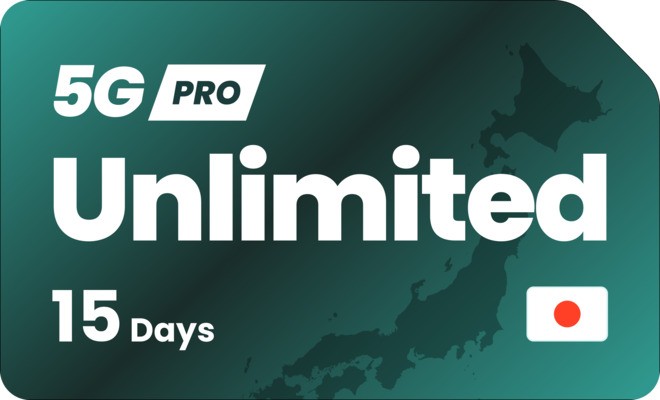
Journey Japan eSIM checks all of these. It runs direct on Japan's local networks and IP for the fastest speeds around. Connecting to NTT Docomo and KDDI networks, offers genuinely unlimited data plans without daily caps or throttling, supports hotspot tethering, and provides English-speaking support based in Japan. Plans run for up to 30 days, making it well-suited for trips of any length within that window.
Conclusion
Choosing between pocket WiFi and eSIM for Japan comes down to three things: how many people you're traveling with, whether your device supports eSIM, and how you like to travel. For most solo travelers and couples with compatible phones, eSIM is the faster, lighter, and more convenient option.
For families, small groups that stay together, or anyone with devices that don't support eSIM, pocket WiFi is still a fair and practical choice.
If you're going the eSIM route and want a plan built specifically for Japan, not a generic global eSIM roaming onto whatever network is available, Journey Japan eSIM offers reliable coverage, real unlimited data, and support that's actually in the same time zone as you. That combination makes Japan travel WiFi one less thing to stress about before your trip.
Frequently Asked Questions (FAQs)
1. Can I use an eSIM if my phone is locked to my home carrier?
No. A carrier-locked phone won't activate an eSIM from a different provider. Contact your carrier to request an unlock before your trip. Most carriers will unlock your device if your account is in good standing.
2. Does an eSIM let me keep my home phone number active?
Yes. Your physical SIM and eSIM run at the same time. You can still receive calls, texts, and two-factor authentication codes on your regular number while using the Japan eSIM for data.
3. What if I run out of data mid-trip?
It depends on the provider. Some allow you to top up or purchase a new plan directly through their website. Choosing a provider with a genuinely unlimited plan avoids this situation altogether.
4. Is pocket WiFi available without pre-booking?
Some airport counters offer walk-in rentals, but availability isn't guaranteed and prices tend to be higher. Pre-booking online before your trip is the safer and usually cheaper route.
5. Can I use an eSIM on an iPad or laptop?
Some iPads support eSIM, but most laptops do not. If you need internet on a non-phone device, pocket WiFi is the more practical option. Alternatively, some eSIM plans support hotspot sharing, so you can connect your iPad or laptop through your phone.

4.9
USD
$84
Nuevo
4.9
USD
$59