Publicado en
5 min
leer
/
Por
Clay Thomas
Getting an eSIM card for Japan is one of the smartest things you can do before your trip. Why you may ask? No airport lines, no SIM tray fumbling, and no surprise roaming bill. Still, a lot of first-time Japan travelers aren't sure how it all works. This guide covers everything, from what an eSIM is to which plan fits your trip.
What Is an eSIM and How Does It Work
An eSIM (embedded SIM) is a digital SIM card built directly into your phone. There's no physical chip to insert or swap. You download a carrier profile onto your device and connect to a mobile network just like you normally would but in a country you are traveling.
The big difference from a traditional SIM card? Everything is handled online. You buy a plan, receive a QR code by email, scan it with your phone, and you're all set. No store visits, no shipping, no waiting.
For international travel, this matters a lot. Your home SIM stays in your phone the whole time. You can still receive calls and texts on your regular number, while a separate Japan data plan runs in the background, giving you access to all your favorite apps and functions as you travel.
Why Japan Travelers Need Reliable Mobile Data
Think about everything you rely on for data before you travel. Now thin about everything you'll depend on the moment you land:
Google Maps for navigating Japan's layered train system
Google Translate for menus, signs, and conversations
Transit apps for real-time platform and schedule updates
QR code payments at restaurants and convenience stores
Emails to stay up to date on bookings and time changes
All of it needs a live, reliable data connection.
Public Wi-Fi in Japan has improved, but it's still inconsistent. Hotspots exist in various places like train stations and convenience stores. However, coverage drops the second you step outside, and logging into multiple networks all day gets old fast.
Japan also has a lot of ground beyond just the main cities. Whether you're in the mountain side region of Nagano, rural are of Kyushu, or even a small island around Okinawa, you need a connection that holds up out there. Not just in Tokyo.
Is Your Phone Compatible with an eSIM Card for Japan
Before anything else, it is crucial to confirm your phone supports eSIM. Most modern smartphones do, but it's worth checking before you buy.
Compatible devices usually include:
iPhone XS and newer (iPhone 14, 15, 16, and 17 in the US are eSIM-only)
Google Pixel 3 and newer
Samsung Galaxy S20 and newer
Most recent flagship Android devices
While this shortlist is accurate, specific regions and models can sometimes vary.
To check on iPhone: Go to Settings, tap General, then About. Look for "Digital SIM" or a listed IMEI under that section.
To check on Android: Go to Settings, then Connections, then SIM Manager. If there's an option to add an eSIM, your phone is compatible.
Your phone also needs to be unlocked. A carrier-locked device may not activate a plan from another provider, even if it supports eSIM. Contact your carrier and request an unlock before your trip. Best to request a few days before to allow for updates to take effect.
How to Set Up and Activate Your eSIM Before Departure
To activate Your eSIM, the whole process is faster than most people expect. Here's how it works.
Purchasing the Plan Online
Choose a plan that matches your trip length and data needs. JJESIM offers 30-day plans built for Japan travel, with coverage on Japan's top local networks like NTT Docomo and KDDI, giving you network access across 99% of the country.
Once you complete your purchase, a QR code arrives in your email immediately. No waiting, no processing delays.
Installing the eSIM at Home
Install the eSIM before you leave home is recommended. You will typically have a stronger Wi-Fi connection to scan the QR code and download the carrier profile more easily. Not to worry if you forget, as you can always connect once you arrive in Japan using airport Wi-Fi.
On iPhone: Settings, tap Cellular or Mobile Data, then Add eSIM. Choose "Use QR Code" and scan.
On Android: Settings, then Connections, then SIM Manager, then Add eSIM. Follow the prompts to scan.
Once installed, the eSIM sits on your phone ready to go. No need to activate it yet.
Activating on Arrival in Japan
When your plane lands, you should be able to connect right away. Turn on mobile data and enable data roaming for your Japan eSIM. Your phone connects automatically to the local network. Before you clear immigration, you're already online.
No kiosk lines. No language barriers. No SIM swap at baggage claim.
Choosing the Right eSIM Card for Japan Plan for Your Trip

Picking the right eSIM card for Japan plan comes down to how you use your phone on the road.
Light users (light maps, messaging, browsing) can get by with a smaller data allocation
Heavy users (gaming, streaming, remote work, video calls, content uploads) should consider a larger or unlimited plan
Group travelers should confirm hotspot sharing is included. JJESIM plans support it, so one eSIM can cover a travel companion's device too
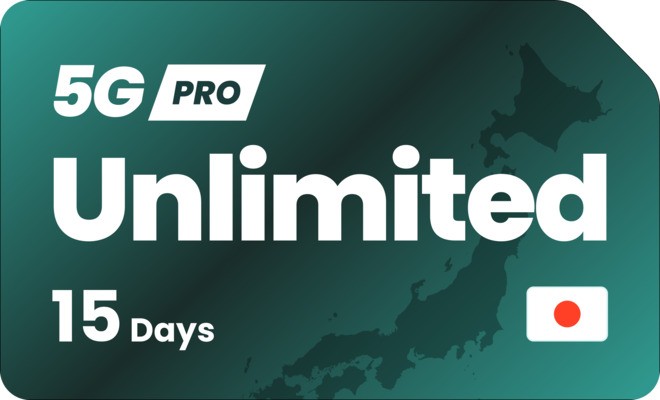
One thing worth knowing on unlimited plans: some data options throttle speeds after hitting a daily data cap. This rarely gets spelled out before purchase. Plans without daily throttling are worth it for anyone relying heavily on data, especially in rural areas.
A Japan-specific eSIM on a local network also outperforms generic global plans. Global plans often route traffic internationally, adding latency and slower speeds even when signal looks strong.
Network Coverage Across Japan
Japan runs on three main mobile networks: NTT Docomo, KDDI, and Softbank. Which one your eSIM connects to affects performance, especially outside the cities.
NTT Docomo covers mountainous regions, rural towns, Shinkansen tunnels, and remote islands like Okinawa. A reliable nationwide network.
KDDI and Softbank perform well in urban centers like Tokyo, Osaka, Kyoto, and Nagoya with high speed performance preferred.
JJESIM runs on multiple local network providers. That's why travelers report strong performance even in areas where other eSIMs fall short.
eSIM vs. Other Connectivity Options in Japan
Here's how an eSIM stacks up against the common alternatives.
Pocket Wi-Fi rentals require airport pickup, daily carrying, charging, and a return before you fly out. They share one connection across multiple devices, which slows things down. An eSIM travels in your phone and adds nothing to your bag.
Physical tourist SIM cards are available at airports and electronics stores. Using one means swapping out your current SIM and losing access to your home number. Some providers also require passport verification on the spot.
International roaming through your home carrier feels convenient but is usually the most expensive option. US carrier roaming rates can add up quickly over a week or two-week trip, charging 300% or more for worse connection.
An eSIM for Japan gives you local network speeds, clear pricing, and none of the hardware hassle.
Conclusion
An eSIM card for Japan keeps you connected from the moment you land, without the extra cost, hardware, or airport queues. Fast data on a nationwide network, instant setup, and your home SIM still active the whole time.
The steps are simple: check device compatibility, install before departure, and enable data roaming on arrival.
JJESIM's Japan-specific plans are built for travelers who need fast and reliable coverage across all of Japan. Browse available plans at Journey Japan eSIM and get your eSIM card for Japan sorted before your flight.
Frequently Asked Questions (FAQs)
1. Will the eSIM work the moment the plane lands?
Yes. Install it before departure and enable data roaming on arrival. Your phone connects directly to Japan's local networks like NTT Docomo and/or KDDI. No airport setup needed.
2. Can I still receive calls and texts on my regular number while using a Japan eSIM?
Yes. Your home SIM stays active the entire time. The Japan eSIM handles data separately on it's own private data line, so your regular number still works for calls and texts.
3. Does a Japan travel eSIM include a Japanese phone number?
No. Most Japan travel eSIMs are data-only. For calls, use apps like WhatsApp, FaceTime, or LINE over your data connection.
4. How much data do I need for a Japan trip?
For a one to two-week trip with standard use, 20GB is typically enough for basic use. For social media use, gaming, streaming, hotspot use, or remote work, go with a larger amount or better yet, an unlimited plan.
5. Is ID or passport verification required to purchase?
No. All you need is an email address to receive the QR code. No ID verification, no paperwork, no store visit required.

4.9
USD
$84
Nuevo
4.9
USD
$59